
Brand differentiation explained for UK business leaders

Brand differentiation is the deliberate choice to be meaningfully different in ways your customers genuinely value and your competitors cannot easily copy. It is the strategic foundation that moves a brand from competing on price to competing on worth.
- The three-dimension sweet spot: defensible differentiation sits at the intersection of your genuine internal strengths, the gaps your market leaves open, and the priorities your customers actually care about.
- Differentiation vs positioning: as David Brier warns, confusing the two is the most expensive branding mistake a leader can make. Positioning is a coordinate; differentiation is a felt relationship.
- The business outcome: brands that achieve genuine differentiation reduce customer price sensitivity, build stronger loyalty, and, as Kantar’s analysis of 872 brands shows, contribute to abnormal financial returns.
Table of Contents
- What brand differentiation actually is (and what it isn’t)
- How to find your differentiation sweet spot
- Which route to differentiation fits your situation?
- A six-step process to build and embed differentiation
- How to measure whether differentiation is working
- Common pitfalls that wreck differentiation programmes
- Three UK mini case studies
- How Michaelbell approaches brand differentiation
- Legal considerations and trademark issues in the UK
- Tailoring differentiation for UK consumer behaviour
- Digital and social media as differentiation tools
- Key takeaways
- Why differentiation is the most underrated leadership decision
- Work with Michaelbell on your differentiation programme
- Useful sources for further reading
What brand differentiation actually is (and what it isn’t)
Three terms get used interchangeably in boardrooms. They are not the same thing.
Differentiation is the substance: the unique benefit or experience you deliver that a defined customer segment values and rivals cannot easily replicate. Positioning is the communication of that substance, the place you occupy in a customer’s mind relative to alternatives. Distinctiveness covers the visual and auditory codes (logo, colour, tone) that make you recognisable. Mark Ritson describes this as a dual engine: distinctiveness drives salience; differentiation justifies the premium.

| Dimension | Positioning | Differentiation |
|---|---|---|
| Intent | Claim a mental space | Deliver a unique benefit |
| Timeframe | Can shift with campaigns | Requires sustained investment |
| Business outcome | Awareness and recall | Loyalty and price resilience |
| Risk of confusion | Looks like strategy | Is strategy |
The practical implication: stop treating a new visual identity as a differentiation programme. Refreshing your logo changes distinctiveness. It does not change what you actually do better than anyone else.
- Develop a brand positioning framework before you brief a designer.
- Audit whether your claimed difference is felt by customers, not just documented internally.
How to find your differentiation sweet spot
The three-dimension framework gives you a practical map. Your sweet spot sits where all three overlap.
- Internal strengths: What do you genuinely do better than most? Not aspirationally, but provably.
- Market gaps: Where are competitors consistently falling short, and where do customers feel underserved?
- Customer priorities: What do your best customers say they value most when they choose you over alternatives?
Mapping exercise checklist:
- List three capabilities your team delivers consistently well (use client feedback, not internal opinion).
- Review competitor reviews on Trustpilot and Google to identify recurring complaints in your category.
- Run five customer interviews asking: “What would you lose if we disappeared tomorrow?”
- Map each answer to one of the three dimensions and look for the overlap.
- Identify one candidate differentiator that appears in all three.
Pro Tip: True differentiation requires trade-offs. As the research makes clear, trying to serve every segment prevents you from being genuinely distinctive for any of them. Choose who you are not for, and your proposition sharpens immediately.
Understanding your brand perception gap is often the fastest way to surface where the market sees you differently from how you see yourself.
Which route to differentiation fits your situation?
Seven practical levers exist. Pick one primary lever and one or two supporting ones. Attempting to differentiate across every axis dilutes the message.
- Product: A UK fintech that builds compliance features directly into its interface, removing a pain point every competitor treats as the customer’s problem.
- Service: A professional services firm that guarantees a named senior contact on every project, not a rotating junior team.
- Channel: A food brand that sells exclusively through independent farm shops, making provenance part of the purchase experience.
- Relationship: A B2B supplier that embeds a dedicated account manager inside the client’s weekly planning cycle.
- Price: A challenger brand that publishes full cost breakdowns, turning transparency into a trust signal in a market known for opaque pricing.
- Image: A heritage manufacturer that leans into British craft credentials at a time when “made locally” carries genuine purchase weight.
- Personnel: A consultancy that differentiates on the seniority and specialism of the people who actually do the work, not just pitch it.
When to use each: startups with limited budgets often find the most traction through relationship and personnel levers, where large incumbents are structurally slow. Commoditised markets respond well to image and channel plays. Service businesses with undifferentiated outputs should look hard at personnel and relationship first.
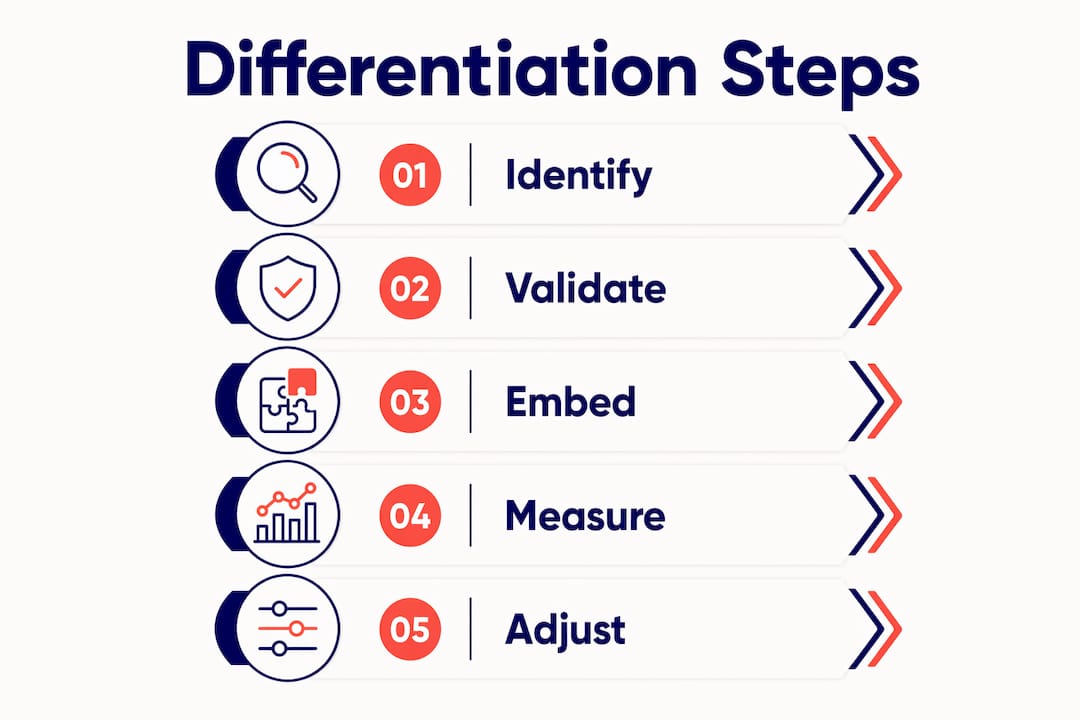
A six-step process to build and embed differentiation
The sequence matters. Skipping the audit and going straight to creative is the most common failure mode.
- Audit (weeks 1–3, internal team): Map current perceptions, touchpoints, and competitor claims. Use signs your brand needs a refresh as a diagnostic prompt.
- Research (weeks 3–6, agency or internal): Customer interviews, competitor analysis, category mapping. Budget: a few thousand pounds depending on scope.
- Choose your lever (week 7, leadership): Select one primary differentiator. Document the trade-offs you are accepting.
- Prototype and test (weeks 8–12, agency-led): Develop two or three executions of the differentiator across key touchpoints. Test with a sample of existing and prospective customers.
- Embed (months 4–6, cross-functional): Rewrite brand guidelines, train customer-facing teams, update every touchpoint from email footers to invoices. Internal communications are not optional here.
- Govern (ongoing, quarterly): Assign ownership. Run quarterly audits against your KPIs.
Questions to ask an agency when briefing: How do you validate a differentiator before we invest in execution? Who owns governance after launch? Can you show us how a previous client’s differentiation held up at minor touchpoints?
How to measure whether differentiation is working
Measurement requires a blend of behavioural, attitudinal, and commercial KPIs. Without a baseline, you cannot prove progress.
| KPI | What it measures | Cadence | How to interpret movement |
|---|---|---|---|
| Price realisaton rate | Whether you are receiving the premium your positioning implies | Monthly | Declining rate signals differentiation is eroding |
| Customer retention rate | Loyalty driven by genuine point of difference | Quarterly | Below category average suggests weak differentiation |
| Unaided brand attribute recall | Whether customers associate you with your chosen differentiator | Bi-annually | Low recall means the market isn’t perceiving the difference yet |
| Net Promoter Score by segment | Advocacy strength among your core audience | Quarterly | Divergence between segments reveals where differentiation lands |
| Share of wallet | Depth of relationship with existing customers | Quarterly | Flat or declining share suggests alternatives are gaining ground |
Set your baseline in month one before any differentiation work goes live. For UK market research, a moderate-sized sample is sufficient for directional attitudinal data in most B2B categories. Review the full dashboard quarterly with your leadership team, not just your marketing function.
Common pitfalls that wreck differentiation programmes
The most frequent failures arise when differentiation is either only documented or insufficiently exclusive.
- Trying to be everything: the fastest route to being nothing. If your differentiation statement applies to every competitor in your category, it is not a differentiator.
- Relying on visual codes alone: distinctiveness is necessary but not sufficient. A new logo without a new behaviour changes nothing customers experience.
- Failing to operationalise: differentiation that lives only in documents is undermined the moment a customer receives a generic invoice or a templated support email.
- Copying competitors: benchmarking is useful; mimicking is fatal. You end up more similar, not more distinct.
- No internal buy-in: if your customer service team does not know what makes you different, they cannot deliver it.
Red flags that signal a programme needs pausing:
- Price sensitivity is increasing despite differentiation investment.
- Customer interviews reveal no consistent understanding of what makes you different.
- Brand attribute recall is flat after two measurement cycles.
- New joiners cannot articulate the differentiator without reading the guidelines.
Three UK mini case studies
A challenger insurance brand built its differentiator entirely around claim speed, guaranteeing a decision within 24 hours and publishing its average response time publicly. The outcome: retention rates significantly above the category average within 18 months.
- Lesson: a process advantage, made visible and measurable, is as powerful as a product advantage.
A regional professional services firm stopped competing on price against national players and instead differentiated on sector depth, serving only three industries and publishing detailed sector reports quarterly. New business conversion improved markedly because prospects arrived already convinced of the firm’s expertise.
- Lesson: narrowing your audience sharpens your proposition. Exclusion is a feature, not a weakness.
A UK B2B software company embedded its differentiator in onboarding: every new client received a named implementation lead who stayed on the account permanently. The product was comparable to alternatives; the relationship model was not.
- Lesson: authenticity in branding means delivering the promise at every stage, not just in the sales deck.
How Michaelbell approaches brand differentiation
Michaelbell’s operating principle is simple: we work as an extension of your team, not as an outside vendor. That means our differentiation work is built to be operationalised, not filed away.
Typical deliverables in a differentiation engagement:
- Brand and communications audit (internal strengths, market gaps, customer priorities)
- Differentiation map with primary and secondary lever recommendations
- Prototype campaigns tested against target audience segments
- Governance pack: touchpoint checklist, brand guidelines update, internal training brief
Calum leads Michaelbell’s brand strategy work.
Legal considerations and trademark issues in the UK
Protecting a differentiated position in the UK requires more than a strong brand idea. Once you have identified your differentiator, register the distinctive elements with the Intellectual Property Office. A UK trade mark gives you exclusive rights to use a name, logo, or slogan in your registered classes of goods or services, and is enforceable against imitators.
Key points for UK business leaders:
- Trade mark registration costs from £170 for one class online (IPO, current schedule). Protect the classes where your differentiation is most commercially exposed.
- Unregistered marks carry some common law protection under the tort of passing off, but litigation is costly and harder to win without registration.
- If your differentiator involves a distinctive process, consider whether it qualifies for design right or patent protection alongside trade mark registration.
- Monitor the market actively. A differentiated position that is copied and not challenged loses both commercial and legal strength over time.
Tailoring differentiation for UK consumer behaviour
UK consumers tend to reward understatement, scepticism of hyperbole, and proof over promise. A differentiation claim that works in a US market context can land as overreach in Britain.
Practical adjustments for the UK market:
- Lead with evidence, not aspiration. UK buyers respond better to “our clients stay with us for an average of four years” than to “we are the UK’s most trusted agency.”
- Humour and self-awareness, used carefully, are genuine differentiators in categories dominated by corporate earnestness.
- Regional identity carries purchase weight in sectors like food, drink, and professional services. “Made in Yorkshire” or “London-based, nationally delivered” are not just geographic facts; they are trust signals.
- UK B2B buyers are particularly sensitive to relationship continuity. Differentiating on named contacts and senior access resonates strongly in professional services, legal, and financial categories.
- Understanding your target audience at a granular level is the prerequisite for any culturally tuned differentiation claim.
Digital and social media as differentiation tools
Gartner research cited by Frontify found that 46% of customers cannot tell the difference between most brands’ digital experiences. That gap is an opportunity.
Digital channels amplify differentiation when the content, tone, and experience are consistent with the core differentiator, and erode it when they are not. A brand differentiating on expertise should publish genuinely expert content, not generic category advice. A brand differentiating on relationship should respond to social comments personally, not through templated replies.
Practical moves:
- Audit your digital touchpoints against your differentiator. Does your website, email programme, and social presence reinforce the same point of difference, or contradict it?
- Use LinkedIn for B2B differentiation through thought leadership tied directly to your chosen lever. Sector-specific insight, published consistently, builds the attribute recall your KPIs track.
- Align brand strategy with your broader business goals before committing to a content or channel plan.
Key takeaways
Brand differentiation works when it is built at the intersection of genuine strengths, real market gaps, and customer priorities, then operationalised across every touchpoint.
| Point | Details |
|---|---|
| Find the sweet spot | Map internal strengths, market gaps, and customer priorities to identify a defensible differentiator. |
| Choose one primary lever | Pick one main route (product, service, relationship, etc.) and one or two supporting levers; avoid spreading across all seven. |
| Operationalise relentlessly | Embed the differentiator in every touchpoint, from invoices to onboarding, not just in brand guidelines. |
| Measure with a blended dashboard | Track price realisation, retention, and unaided attribute recall quarterly from a pre-set baseline. |
| Michaelbell as your partner | Michaelbell delivers end-to-end differentiation programmes, from audit and mapping through to governance, as an extension of your team. |
Why differentiation is the most underrated leadership decision
Most leaders treat brand differentiation as a marketing project. It isn’t. It is a strategic choice about what your organisation will be exceptional at, who it will serve, and which activities it will configure to sustain that exceptionalism. The brands that get this right do not just win more customers; they attract better ones, retain them longer, and spend less energy defending their price.
The uncomfortable truth is that genuine differentiation requires courage. It means saying no to segments that do not fit, resisting the temptation to add features that blur your focus, and holding the line when short-term pressure argues for a compromise. That discipline is rarer than the strategy itself.
Work with Michaelbell on your differentiation programme
Michaelbell gives marketing leaders the depth of an in-house brand strategy team without the overhead. We run the full differentiation process, from diagnostic audit through to governance, and we stay embedded until the difference is felt by your customers, not just approved by your board.
What to expect in an initial engagement:
- Diagnostic: a structured audit of your current position, competitor gaps, and customer priorities, delivered within two to three weeks.
- Pilot: a tested differentiation map with lever recommendations and prototype creative, ready to pressure-test with your audience.
- Governance: a practical pack your team can run independently, including touchpoint checklists and a quarterly review framework.
Talk to us about your differentiation challenge. Visit our services page to see how we work and get in touch.
Useful sources for further reading
These are the sources worth bookmarking if you want to go deeper on brand differentiation strategy.
- Kantar: Is brand differentiation effective? — The most rigorous quantitative case for differentiation, drawing on BrandZ data across 872 brands. Essential reading for leaders who need to make the business case internally.
- Wikipedia: Product differentiation — A clear grounding in the economic theory, from Chamberlin’s 1933 framework through to Porter’s generic strategies. Useful context for understanding why differentiation is a structural, not cosmetic, choice.
- Forbes Agency Council: The strategic art of brand differentiation — Practitioner-level guidance on operationalising differentiation, with particular emphasis on touchpoint governance.
- Rising Above The Noise: The art of differentiation — David Brier’s perspective on why differentiation must be felt, not just documented. Short, direct, and worth reading before any briefing session.
- Michaelbell: Brand communications services — How Michaelbell structures differentiation engagements for UK business leaders, from audit through to embedded governance.