
How to establish brand consistency at the early stage

Brand consistency is the deliberate, repeated use of defined brand elements — visuals, tone, messaging, and customer experience — to create a recognisable identity from day one. Get it right early, and you build trust faster, reduce internal confusion, and give customers a reason to come back. Get it wrong, and every new channel you open makes the problem harder to fix.
The marketing “Rule of 7” captures why repetition matters: customers typically need multiple encounters with a brand before they remember or trust it. That means inconsistency does not just look unprofessional. It actively resets the clock on recognition every time it happens.
What brand consistency means and why it matters from the start
Brand consistency means every touchpoint — your website, social posts, email signatures, sales calls, and packaging — reflects the same visual identity, voice, and values. It is not about being rigid. It is about being recognisable.
For early-stage companies, the benefits are concrete:
- Faster customer recall. Repeated exposure to the same colours, typefaces, and tone trains recognition without paid media.
- Trust and referrals. When customer expectations are met predictably, people recommend you to others.
- Internal alignment. A shared brand language means your sales team and your content team say the same things about you.
- Reduced dilution. Consistent messaging across channels prevents the fragmented impression that makes early-stage brands look amateur.
- A foundation to build on. Consistency now makes future brand evolution deliberate rather than chaotic.
The earlier you lock in these foundations, the less rework you face when your team grows or your channels multiply.
Core elements every early-stage brand must define
Early-stage brands do not need a 60-page brand book. They need a small set of clearly defined elements applied without exception. Here is what that looks like in practice:
Visual elements:
- One primary logo (and a simplified version for small formats)
- A limited colour palette — two or three colours at most
- Two typefaces: one for headlines, one for body copy
- Basic image style guidance (photography tone, illustration use, or both)
Messaging elements:
- A concise positioning statement that answers why you exist from your customer’s perspective
- Three to five core brand values, expressed in plain language
- A defined tone of voice: formal or conversational, warm or authoritative, and so on
Delivery elements:
- A consistent content style across blog posts, social media, and email
- A standard approach to customer interactions, from first enquiry to post-purchase follow-up
- Social media templates that apply your visual identity without requiring a designer each time
The goal at this stage is simplicity. Core elements for a minimum viable brand include a clear logo, limited colours, two typefaces, and a focused positioning statement. Anything beyond that can wait until you have product-market fit and real customer data to inform it.
Pro Tip: Before you finalise your colour palette or typefaces, check how they render on mobile. Most of your audience will encounter your brand on a small screen first.
Why brand consistency matters specifically for UK brands
The UK business environment is competitive and multichannel. Consumers move between Instagram, Google, email, and in-person interactions with the same brand in a single day. Consistent branding establishes credibility and trust in that environment, particularly for early-stage firms that do not yet have the reputation of an established name.
Here is what consistency delivers in the UK market specifically:
- Market recognition. Uniform use of your colour palette and typography reinforces recognition across every channel, from LinkedIn to trade press to packaging.
- Credibility with buyers and partners. UK B2B buyers in particular scrutinise brand presentation as a proxy for operational quality. A polished, consistent brand signals that you run a tight ship.
- Smoother customer journeys. Small inconsistencies across touchpoints create friction, even when each individual touchpoint seems fine on its own. Consistency removes that friction.
- Reduced brand dilution. Inconsistent use of visual elements erodes consumer trust rapidly, while uniform use builds it.
- Better feedback loops. When your brand is consistent, customer feedback tells you something meaningful. When it is not, you cannot tell whether a negative reaction is about your product or your presentation.
For UK startups and SMEs, early brand consistency is also a competitive differentiator. Most early-stage businesses underinvest here, which means getting it right puts you visibly ahead. Understanding why brand consistency drives growth is the first step to treating it as a business priority rather than a design exercise.
Practical steps to maintain brand consistency from day one
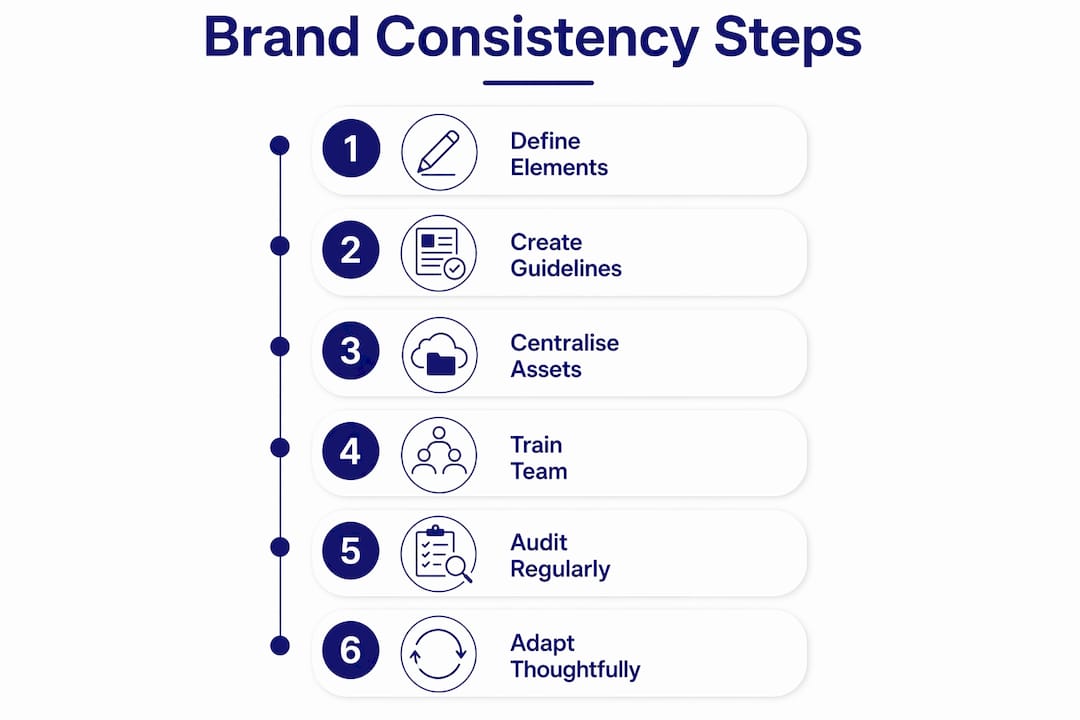
Consistency does not happen by accident. It requires clear systems, shared assets, and regular checks. These are the steps that actually work in practice:
1. Create concise brand guidelines and share them widely.
Well-defined brand guidelines unify team understanding and ensure consistent application across every channel. Keep them short enough that people actually read them. Include your logo rules, colour codes, typefaces, tone of voice, and a few do-and-don’t examples. Pin them to your team’s shared workspace so they are impossible to overlook.

2. Centralise your brand assets with version control.
A shared digital asset management system prevents outdated logos, inconsistent templates, and old copy from circulating. Even a well-organised shared folder beats having assets scattered across individual laptops. The key is that everyone accesses the same approved files.
3. Train your whole team, not just marketing.
Regular training enables organisation-wide brand alignment. Sales, customer service, and operations teams all represent your brand in their interactions. A 30-minute onboarding session and a one-page brand reference card goes a long way.
4. Audit your materials periodically.
Monthly spot checks on social content, email campaigns, and site copy, combined with a more thorough annual review, help prevent drift. Use your brand guidelines as the benchmark, not last month’s campaign.

5. Adapt thoughtfully as you grow.
Brand evolution is normal. The messaging that works for your first ten customers will not work for your first hundred. Build a simple feedback loop: log how prospects discover you, what they think you do initially, and what shifts their understanding. That data shapes your positioning more accurately than any internal workshop.
Pro Tip: Use customer conversation data to refine your messaging dynamically. Record sales calls, extract the recurring phrases customers use to describe their problems, and update your website copy monthly based on what you are actually hearing.
Aligning your brand with your broader business goals is equally important. A brand that looks consistent but pulls in a different direction from your commercial strategy creates confusion at a deeper level. Aligning brand strategy with business goals is the discipline that keeps both in step.
Building a minimum viable brand: the expert approach for early-stage companies
The Minimum Viable Brand (MVB) is the expert-recommended framework for early-stage brand consistency. The principle is straightforward: build only what you need to be consistent, ship it, and iterate from real market feedback rather than theoretical planning.
Brand strategy for startups makes the case plainly: consistency beats creativity at the early stage. Startups that spend months perfecting logo variations while using different fonts in every customer-facing document are solving the wrong problem. Fix the basics first.
The MVB rests on three pillars:
- Core message. Not your mission statement. The specific problem you solve, described in the words your customers actually use. Extract this from sales calls and customer conversations, not a conference room.
- Visual consistency. One primary colour, one headline font, one body font. Five templates: email signature, slide deck, one-pager, social post, blog header. Use them everywhere.
- Voice. This develops through content creation, not planning. Ship one content format consistently for three months and document the patterns: how you structure explanations, what examples you reach for, what tone feels authentic.
The MVB approach also means extracting brand elements from existing workflows rather than running a separate brand project. Your sales calls, customer emails, and product demos already contain your brand. The job is to surface it, document it, and apply it consistently.
For founders building their first visual identity, a founder’s guide to visual identity components covers the practical decisions around logos, palettes, and typography without overcomplicating the process.
Pro Tip: Begin with one content format you genuinely enjoy producing. A newsletter, a short video series, or a LinkedIn thread. Ship it consistently for 90 days. Your brand voice will emerge from the repetition, not from a tone-of-voice document.
Brand measurement at this stage is about checking whether the system works, not running awareness studies. Track three behavioural signals: are prospects accurately describing what you do when they refer others? Are customers using your language when they explain your value? Are team members explaining your product consistently on sales calls? If the answer to all three is yes, your brand is working. Visual storytelling is one of the most effective ways to reinforce that consistency across channels, particularly on social media where attention is short.
Michaelbell helps you build brand consistency without the agency overhead
Getting brand consistency right early is one of the highest-return investments a growing business can make. But most early-stage teams do not have the time, budget, or in-house expertise to do it well on their own.
Michaelbell is the alternative to a traditional agency for early-stage brand communications. We work as an embedded partner, not an outside vendor, which means you get the creative expertise and strategic thinking of a full agency at a fraction of the in-house cost. We specialise in unifying external brand communications with internal team alignment, so your brand is not just consistent on your website but consistent in every sales call, every email, and every customer interaction. Whether you need to build your brand identity from scratch or bring coherence to a brand that has grown faster than its guidelines, our brand communications services are built for exactly this challenge. Get in touch and we will get straight back to you.
Key takeaways
Establishing brand consistency at the early stage requires a small set of clearly defined elements applied without exception across every channel and team.
| Point | Details |
|---|---|
| Start with the minimum viable brand | Define one logo, a limited colour palette, two typefaces, and a concise positioning statement before anything else. |
| Centralise assets and guidelines | A shared digital asset management system prevents outdated materials from circulating and keeps every team member on-brand. |
| Train beyond the marketing team | Sales, customer service, and operations all represent your brand; a one-page reference card and a short onboarding session creates alignment fast. |
| Extract brand from real conversations | Record sales calls and customer interactions to surface the language and positioning that actually resonates, then document it. |
| Michaelbell for early-stage brand comms | Michaelbell works as an embedded partner to build and maintain brand consistency without the overhead of a traditional agency. |