
What is brand perception gap? A 2026 guide for marketers

The brand perception gap is the distance between how your brand intends to be seen and how customers actually see it. It’s not a messaging problem. It’s a reality problem. When your brand promises one thing and customers experience another, that gap forms at every touchpoint: the product itself, the purchase process, the customer service interaction, and the conversation customers have about you afterwards.
Understanding this gap is the starting point for any serious brand alignment work. Here’s what typically drives it:
- Messaging vs reality: Your communications claim “effortless” but the onboarding process takes three phone calls.
- Service quality mismatch: You position as premium, but response times tell a different story.
- Brand promise vs delivery: The brand promise sets an expectation that the product or team consistently fails to meet.
- Internal inconsistency: Marketing says one thing; the sales team says another; the product does a third.
- Cultural blind spots: A brand built around one regional audience lands differently with customers elsewhere in the UK.
Every brand has a perception gap. The question is whether yours is narrow enough to refine, or wide enough to undermine your strategy.
Why the brand perception gap can make or break your brand
A perception gap left unaddressed erodes the foundations of brand equity quietly and quickly. Customers don’t usually tell you they’ve lost trust. They just leave, or they stay but stop recommending you.
The consequences compound fast:
- Reduced brand equity: When perception drifts from identity, the premium customers are willing to pay shrinks.
- Higher churn: Customers who feel misled don’t give second chances, particularly in competitive UK markets.
- Damaged reputation: Negative word of mouth travels faster than any campaign can counter.
- Lower engagement: Audiences tune out messaging that doesn’t match their lived experience of your brand.
- Missed conversion: Prospects who sense a gap between your claims and your reviews walk away before buying.
The data is stark. Research into brand perception gaps reveals that 70% of brands overestimate how differentiated customers consider them, and 60% misjudge which attributes customers associate most strongly with their brand.
For UK brand managers in 2026, this matters more than ever. Customers have more ways to verify your claims before they buy, from Trustpilot ratings to LinkedIn conversations to Reddit threads. The gap between what you say and what customers experience is increasingly visible, and increasingly costly.

How to conduct a brand perception gap analysis
A solid gap analysis combines numbers with human insight. Quantitative metrics alone are insufficient; the most effective approach blends them with qualitative research to uncover the emotional drivers behind customer perception.

Step 1: Define your intended brand identity
Write down precisely how you want customers to perceive your brand. Not your values statement. The actual words you’d want a customer to use when describing you to a colleague.
Step 2: Gather quantitative data
- Run brand perception surveys using tools like Typeform to capture structured feedback at scale.
- Track Net Promoter Score (NPS) and CSAT on a quarterly basis, not just after campaigns.
- Monitor branded search volume trends and review sentiment on platforms like Trustpilot and Google.
- Pull churn rates, conversion rates, and customer lifetime value to identify where perception gaps are costing you most.
Step 3: Gather qualitative data
- Conduct customer interviews and focus groups to hear the language customers actually use about your brand.
- Use social listening tools such as Brandwatch to track mentions, sentiment, and conversation themes across social platforms and forums.
- Analyse open-text survey responses to identify recurring associations, both positive and negative.
Step 4: Map the gap
Compare your intended identity against your measured perception. Where do they align? Where do they diverge? The divergences are your priorities.
Step 5: Cross-reference with behavioural data
Pair perception findings with metrics like churn and conversion. If quality perception is high but churn is also high, the gap may sit in value perception or service experience rather than product quality.
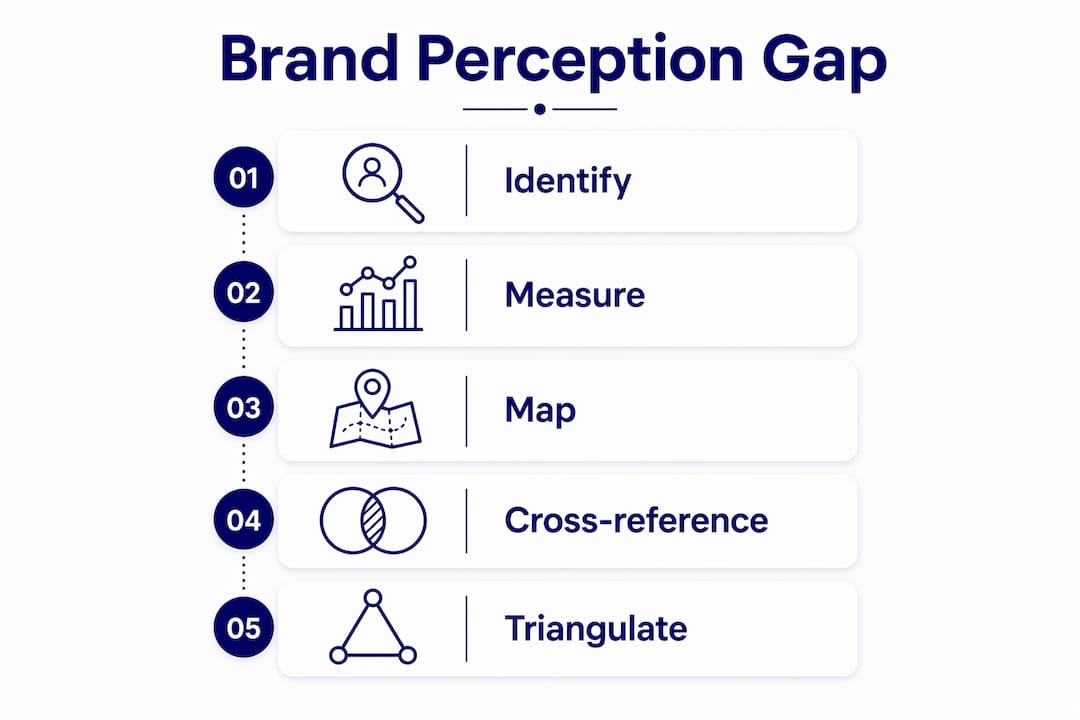
Pro Tip: Don’t rely on a single survey. The most revealing insights come from triangulating survey data, social listening, and direct customer conversations. Each method catches what the others miss.
Signs your brand has a perception gap right now
Some perception gaps are obvious. Most aren’t. These are the signals worth watching:
- Inconsistent customer feedback: Customers describe your brand in wildly different terms, with no coherent theme.
- High churn despite strong messaging: Your campaigns perform well on reach but customers aren’t staying.
- Low engagement on brand content: People interact with your product posts but ignore your brand story content.
- Internal disconnect: Your marketing team and your customer experience team have different answers when asked what the brand stands for.
- Unexpected competitor wins: You’re losing deals to brands you consider inferior, often because customers perceive them as more reliable or more relevant.
- Review sentiment that surprises you: The words customers use on Trustpilot or Google don’t match the words in your brand guidelines.
- Rising support volume around the same issues: Repeated complaints about the same touchpoint signal a promise-delivery failure, not a one-off.
In UK markets specifically, regional variation can amplify these signs. A brand that resonates strongly in London may feel distant or generic to customers in Manchester, Edinburgh, or Cardiff, particularly if the communication style doesn’t reflect local expectations.
Recognising these signs early is what separates brands that course-correct from those that spend years wondering why growth has stalled. The signs your brand needs a refresh often start here, in the gap between what you’re saying and what customers are hearing.
Effective strategies to close the brand perception gap
Closing the gap requires more than a new campaign. The root cause is almost always a failure to deliver on brand promises, not a failure to communicate them. Fix the experience first; then align the messaging.
Practical steps to close the gap:
- Improve the actual customer experience: Audit every touchpoint where your brand promise meets reality. Fix the friction points before you amplify the message.
- Align internal teams: Marketing, sales, customer service, and product must share a single, clear understanding of what the brand stands for. Internal misalignment surfaces externally, every time.
- Refine your communication strategy: Once the experience is right, update your messaging to reflect what customers actually value about you, using their language, not yours.
- Deliver consistently: Brand perception builds through repeated exposure. One great interaction doesn’t close a gap; consistent delivery does.
- Act on feedback publicly: Responding to reviews and complaints visibly signals that your brand listens. UK customers notice when brands engage, and when they don’t.
- Measure continuously: Brand perception shifts rapidly, sometimes after a single interaction. Quarterly NPS and sentiment tracking keeps you ahead of drift.
Pro Tip: Resist the urge to reposition through messaging alone. If customers perceive you as slow and your service genuinely is slow, a campaign claiming otherwise will widen the gap, not close it. Earn the new perception before you claim it.
What you gain when you close the gap
Closing the perception gap isn’t just about reputation management. The business outcomes are measurable and direct:
- Stronger customer loyalty: Customers who experience what you promise stay longer and spend more.
- Higher conversion rates: Prospects who see alignment between your claims and your reviews convert with less friction.
- Brand advocacy: Satisfied customers who feel understood become your most credible marketing channel.
- Improved brand equity: Consistent delivery on your promise builds the premium that competitors can’t easily replicate.
- Competitive resilience: Brands with strong perception alignment weather market disruption better because customer trust is already banked.
- More efficient marketing spend: When perception and identity align, every campaign works harder because the brand story is already credible.
For UK brand managers targeting growth in 2026, these aren’t soft benefits. They connect directly to the KPIs that matter: retention, lifetime value, net revenue, and share of voice.
Expert insights on measuring and managing the brand perception gap
The most important thing to understand about brand perception is that you cannot fully control it. You can only influence it.
“Brand perception lives entirely in the minds of consumers and is shaped by product quality, customer service, social conversations, and word of mouth. Unlike brand messaging, which a company controls, brand perception is built through experiences, reviews, and word of mouth.”
This distinction changes how you approach the problem. Most marketers focus on messaging because messaging is controllable. But perception is built through experience, and experience is where the gap lives.
Brandwatch’s guidance on continuous monitoring reinforces this: perception can shift rapidly, sometimes after a single negative interaction, which is why measurement needs to be an ongoing discipline rather than an annual exercise. Sentiment analysis and quarterly NPS reviews give you the early warning system you need.
Typeform’s measurement framework makes the practical case for mapping perception against identity systematically, then cross-referencing with behavioural data. If churn is rising while satisfaction scores look healthy, the gap is likely in value perception or service consistency, not product quality.
At Michaelbell, we work with marketing teams who are often surprised to discover that their internal brand understanding and their customers’ actual perception are operating in entirely different registers. The fix rarely starts with a new creative direction. It starts with honest measurement, cross-functional alignment, and a willingness to act on what the data reveals rather than what the team hopes it says.
Pro Tip: Use AI-driven brand awareness measurement alongside traditional NPS and survey methods. AI analytics can surface perception shifts in social and search data weeks before they show up in quarterly survey results.
How cultural and regional factors shape perception gaps in the UK
The UK is not a single, uniform market. Brand perception gaps often widen precisely because brands treat it as one. A tone that reads as confident in London can read as arrogant in Leeds. A campaign built around urban convenience may feel irrelevant to customers in rural Scotland or Northern Ireland.
Regional identity, cultural expectations, and local trust signals all influence how customers receive your brand. In 2026, with UK consumers increasingly sceptical of corporate messaging, authenticity and local relevance carry more weight than production values. Brands that acknowledge regional differences in their communication strategies tend to close perception gaps faster than those that broadcast a single national voice.
Language matters too. The vocabulary your brand uses, the humour it employs, the values it signals, all land differently depending on where your customer is. A brand perception analysis that doesn’t segment by region will miss gaps that are entirely predictable once you look for them.
Why internal brand alignment is the foundation of perception management
The perception gap often starts inside the organisation, not outside it. When marketing, sales, product, and customer service teams hold different versions of what the brand stands for, that inconsistency reaches customers through every interaction.
Internal alignment means every team member understands the brand promise and knows how their role delivers it. An employee perception survey, measuring whether internal teams share the same brand identity understanding as marketing, can reveal alignment gaps that directly affect the customer experience. If marketing positions the brand around speed and simplicity but the operations team prioritises thoroughness over pace, customers will feel the contradiction before they can name it.
Closing the internal gap is a prerequisite for closing the external one. You cannot deliver a consistent brand experience if the people delivering it are working from different briefs.
How to align your marketing communications to address perception gaps
Once you know where the gap sits, your communications need to close it deliberately. That means three things: speaking in your customers’ language, not your brand’s; addressing the specific perceptions that diverge from your identity; and being consistent across every channel.
Start by auditing your current communications against your gap analysis findings. Where are you overclaiming? Where are you underselling genuine strengths? Where are you using language that customers don’t recognise as describing their experience of you?
Then align your brand strategy with what the data tells you customers actually value. Reframe your messaging around those attributes, using the words customers use in reviews and interviews rather than the words your brand guidelines prefer. This isn’t about abandoning your identity. It’s about expressing it in terms that land.
Finally, maintain consistency. A single aligned campaign won’t close a perception gap. Sustained, coherent communication across every touchpoint, from your website copy to your customer service scripts to your social presence, is what shifts perception over time.
How Michaelbell can help you close the gap
At Michaelbell, we specialise in exactly this: connecting what your brand intends to say with what your customers actually hear. Our team works across external creative and internal communications, which means we address perception gaps at their source, not just their surface.
Whether you need a full gap analysis, a communications audit, or ongoing brand alignment support, we work as an extension of your team rather than an outside vendor. Explore our brand communications services and let’s talk about where your gap sits and what closing it could mean for your business.
Key takeaways
The brand perception gap is closed through honest measurement, internal alignment, and consistent delivery on your brand promise, not through messaging alone.
| Point | Details |
|---|---|
| Gap definition | The brand perception gap is the difference between your intended brand identity and how customers actually perceive you. |
| Root cause | Perception gaps stem primarily from promise-delivery failures, not from weak messaging or design. |
| Measurement approach | Combine NPS, CSAT, and surveys with social listening and customer interviews for a complete picture. |
| Internal alignment | Internal team misalignment surfaces externally; closing the internal gap is prerequisite to closing the external one. |
| Continuous monitoring | Brand perception shifts rapidly, so quarterly sentiment tracking and NPS reviews are the minimum cadence. |