
Rebrand without losing customer loyalty: a playbook

A carefully planned, evidence-led rebrand can retain and often deepen customer loyalty. The risk of losing customers is real, but it is almost always a product of poor preparation rather than the rebrand itself.
Three factors make the difference between a rebrand that strengthens relationships and one that erodes them: customer research conducted before any creative work begins, a phased rollout that gives loyal customers time to adjust, and internal alignment so your team communicates changes with confidence. Get those three right, and the odds shift firmly in your favour.
Before you proceed, glance at these baseline signals:
- NPS trend: Is your Net Promoter Score stable or declining? A declining score before a rebrand suggests the brand is already losing relevance, which strengthens the case for change.
- Repeat purchase rate: High repeat rates signal strong habitual loyalty tied to existing brand cues. Protect those cues.
- Brand recall: Can customers describe your brand unprompted? Low recall suggests you have more freedom to change; high recall means signature assets carry real equity.
Tropicana’s packaging redesign is the cautionary benchmark here. The brand reportedly saw a 20% drop in sales after erasing the iconic orange-and-straw image, and reversed course within weeks. The lesson is not that rebrands fail. It is that erasing recognisable cues without customer consent destroys the very equity you are trying to build on.
Table of Contents
- Should you rebrand, or is a lighter fix enough?
- What must stay and what can change? A core identity audit
- How do you involve customers without over-listening?
- Messaging and visual changes: evolve, don’t erase
- How should you phase the rollout?
- How do you measure customer reaction and act fast?
- Common mistakes and a pre-launch checklist
- Why internal alignment is the rebrand factor most leaders underestimate
- Key takeaways
- The rebrand risk most leaders are not managing
- What Michaelbell can do for your rebrand
- Useful sources and further reading
Should you rebrand, or is a lighter fix enough?
Not every brand problem requires a full rebrand. Before committing budget and leadership bandwidth, run a quick sanity check against these legitimate business triggers:
- Strategic repositioning: You are entering a new market, shifting upmarket, or pivoting your proposition.
- Product mix change: Your offer has evolved significantly beyond what the current brand communicates.
- Reputational repair: The existing brand carries associations that actively damage sales or recruitment.
- Legal or naming conflict: A trademark dispute or acquisition forces a name change.
If none of those apply, a lighter intervention is usually preferable. A brand refresh vs rebrand decision often comes down to whether the core identity is still sound. A targeted campaign, a tone-of-voice update, or a customer experience fix can resolve many brand problems at a fraction of the cost and risk. For mature brands with substantial recognition, partial refreshes are often the safer route precisely because they preserve the equity customers already associate with you.
On cost and timeline: a full rebrand for a mid-sized UK business typically runs from several months to over a year, with agency fees, research, production and rollout all adding up. A refresh can often be delivered in six to twelve weeks. Neither figure is fixed, but both should be weighed against the cost of customer churn if the change is handled poorly.
Pro Tip: Delay a rebrand if your business is mid-way through a major service disruption, a merger, or a significant operational change. Customers experiencing friction with your product are already stressed; adding brand confusion on top compounds the problem and inflates churn risk. Wait until service is stable.
Check the nine signals your brand needs a refresh before making a final call on scope.
What must stay and what can change? A core identity audit
The most common creative mistake in rebranding is treating everything as up for grabs. A structured audit prevents that.
Your core identity sits on four axes:
- Purpose and values: Why the business exists and what it stands for. These rarely change; when they do, it is a repositioning, not a rebrand.
- Tone of voice: The personality customers hear in every communication. Abrupt tone shifts feel like meeting a stranger wearing a familiar face.
- Signature assets: The specific visual or verbal cues customers use to recognise you instantly. Think colour, logo mark, a distinctive phrase, or a product shape.
- Product cues: Naming conventions, packaging structures, or interface patterns that customers navigate by habit.
Use your CRM data, NPS verbatims, focus group outputs, and sales patterns to decide what falls into each category. High-value, long-tenure customers are your most reliable auditors; their language about the brand reveals which cues carry genuine emotional weight.
| Element | Preserve | Evolve |
|---|---|---|
| Core colour palette | Yes — unless research shows negative association | Supporting tones and gradients |
| Primary logo mark | Yes — anchor it even if you modernise the wordmark | Logo lockup proportions, spacing |
| Brand purpose statement | Yes | How it is expressed in copy |
| Tone of voice | Core personality traits | Vocabulary, sentence length, formality |
| Product naming | Established product names | Sub-brand architecture |
| Campaign imagery | Signature visual style | Photography treatment, illustration style |
| Supporting typography | Retain if strongly associated | Secondary typefaces, weight hierarchy |

Brand identity clarity has a direct influence on loyalty and engagement. The audit is not a creative constraint; it is a loyalty protection mechanism.
How do you involve customers without over-listening?
Customer research is the single most important pre-rebrand investment, and it is also the most frequently skipped. Here is a prioritised method sequence:
- Short quantitative survey (NPS + targeted items): Send to a stratified sample of customers segmented by value and tenure. Ask what they associate with the brand today, what they would miss if it changed, and how they describe you to others. Keep it under ten questions.
- Online focus groups: Run two or three sessions of six to eight participants. Mix high-value long-tenure customers with recent acquirers. Focus on emotional bonds and recognisability cues, not aesthetic preferences.
- Customer panels: If you have an existing panel or loyalty programme, use it. These customers are already invested and will give you more candid, considered feedback than a cold survey.
- Social listening: Monitor brand mentions, hashtags, and review platforms for unprompted language customers use to describe you. This reveals the vocabulary and cues that matter without the bias of a direct question.
- Qualitative interviews: Five to ten in-depth conversations with your highest-value customers. Ask open questions: “When you think of us, what comes to mind first?” and “What would make you feel this is still the same brand you trust?”
Surveying customers to find what they value about the current brand and what must remain is a practical step that directly reduces the risk of alienating loyal customers. For younger cohorts, note that Gen Z loyalty is driven by value alignment and authenticity rather than habitual recognition, so your research questions should probe values as much as visual cues.
Avoid feedback bias by segmenting responses. Do not let a vocal minority of recent customers override the preferences of your highest-value, longest-tenure segment. If high-value customers object strongly to a proposed change, treat that as a hard stop, not a data point to average out.
Pro Tip: Ask customers to describe your brand in three words before showing them any new creative. Their unprompted language tells you which cues carry the most equity. Build your ‘must preserve’ list from those words, not from internal preference.
Messaging and visual changes: evolve, don’t erase
The guiding principle for creative teams is continuity over novelty. Your job is to modernise the brand’s expression, not replace its personality.
For messaging, the practical rules are:
- Retain the core promise in every piece of customer-facing copy, even if the language around it changes.
- Simplify where the brand has become verbose, but never strip out the personality markers that make the voice recognisable.
- Carry narrative through-lines from old to new. If your brand has always spoken about a specific customer outcome, keep that outcome central even as the framing evolves.
On the visual side, refreshing brand messaging for an existing audience works best when signature palette and logo anchors are treated as non-negotiable. Supporting elements, such as illustration style, photography treatment, and secondary typefaces, are where creative teams have genuine latitude.
Brand consistency across every customer touchpoint is what converts a rebrand from a disruption into a natural evolution. Inconsistency, even brief inconsistency during a transition, is where customer confusion takes hold.
A/B testing is your validation layer before wide rollout. Test new messaging against existing copy on email subject lines and landing pages, tracking open rates, click-through rates, and conversion. For visual changes, test new creative in paid social with a matched audience before committing to packaging or out-of-home production. The metric to watch is not just performance; it is recognition. Ask a sample of customers to identify the brand from the new creative alone. If recognition drops, the change has gone too far.
How should you phase the rollout?
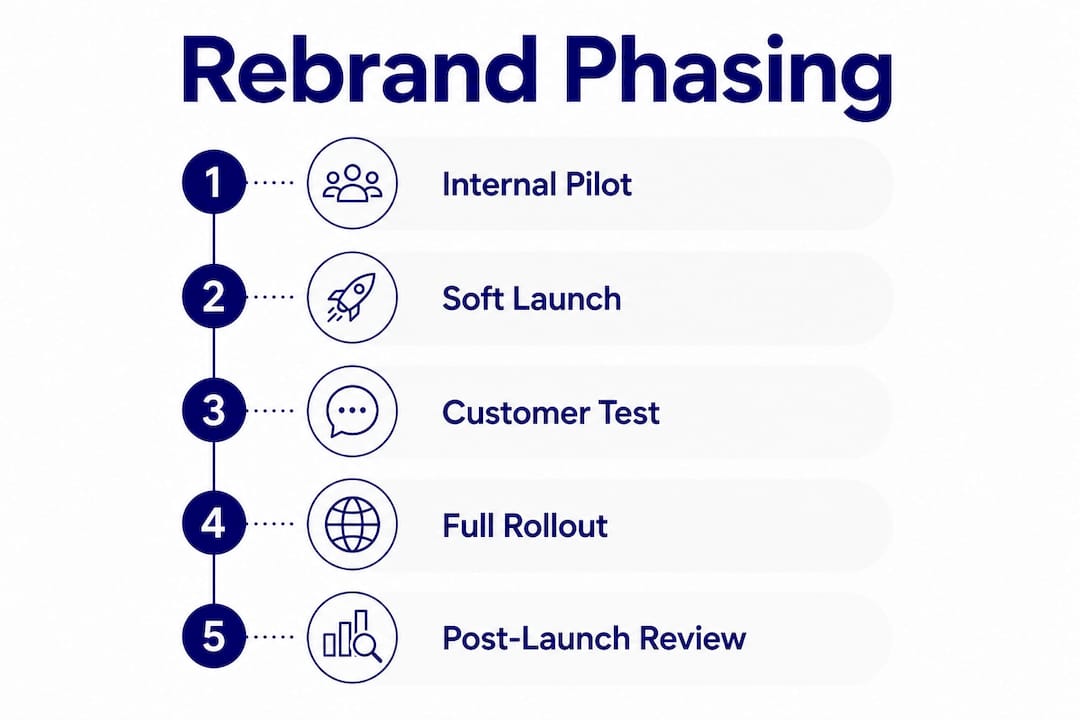
A phased rollout is the single most effective risk control available to you. It gives you real data at each stage before you commit to the next.

Recommended phasing
| Phase | Audience | Key actions | Success threshold |
|---|---|---|---|
| 1. Internal pilot | All employees | Leadership briefing, training modules, brand guidelines distributed | 90%+ staff can explain the change confidently |
| 2. Loyal customer cohort | Top high-value, long-tenure segment | Email preview, early access, feedback survey | NPS stable or improved; no material increase in support contacts |
| 3. Regional or channel pilot | One region or one channel | Soft launch of new creative, monitor sentiment and sales | No significant drop in conversion or brand recall |
| 4. Full public launch | All customers and prospects | Full creative rollout across all channels | Churn rate within pre-agreed tolerance |
Channel sequencing
Roll out changes in this order, and for this reason:
- Customer service scripts and FAQs first: Frontline teams must be ready to answer questions before customers encounter any change.
- Owned email next: Your most engaged customers hear from you directly, in your voice, before they see anything in the wild.
- Product and packaging: Physical changes take longest to produce and distribute; sequence them after digital is live.
- Retail and partner channels: Brief partners and retailers with lead time so they are not caught off-guard.
- Paid media last: Do not spend media budget driving awareness of a new brand before your own customers have been told.
Set a clear contingency trigger at each phase. If NPS drops by more than a defined threshold, or if inbound complaints spike beyond a set volume, pause and investigate before proceeding. Keeping existing clients informed and prioritising service continuity over cosmetic changes during transition is the practical standard to hold yourself to.
- Define rollback thresholds in writing before launch day.
- Assign a named decision-maker with authority to pause or revert.
- Keep legacy brand assets production-ready for at least 90 days post-launch.
How do you measure customer reaction and act fast?
Monitoring is not a post-launch activity. It starts the moment the first pilot goes live.
Primary KPIs to track before, during and after launch:
- NPS: Measure at each phase gate. A drop of more than five points in a cohort warrants investigation before scaling.
- Churn rate: Track weekly during the rollout window. Sudden spikes are the clearest early-warning signal.
- Repeat purchase rate: A leading indicator of habitual loyalty. Watch for softening in the weeks immediately following each phase.
- Brand recall: Run a short prompted and unprompted recall survey with a sample audience at each phase.
- Search behaviour: Monitor branded search volume in Google Search Console. A drop in branded queries can indicate confusion or disengagement.
Your minimum dashboard needs four data feeds: CRM (churn, repeat purchase), web analytics (branded search, direct traffic), social sentiment (volume and tone of brand mentions), and customer service logs (contact reason codes). Most UK businesses can assemble this from existing tools without new investment.
The most dangerous moment in a rebrand is not launch day. It is the two weeks after, when the initial excitement fades and the first confused or frustrated customers start contacting your team. If your frontline is not ready to respond with confidence, that confusion becomes churn. Build your rapid-response playbook before you go live, not after.
Rebrands grounded in research and careful planning are significantly more likely to increase awareness and loyalty rather than erode them. The monitoring infrastructure is what turns that planning into a live feedback loop.
Rapid-response escalation playbook:
- Level 1 (normal): Customer service handles individual queries using pre-approved scripts.
- Level 2 (elevated): Contact volume or sentiment score crosses threshold. Marketing lead reviews within 24 hours.
- Level 3 (critical): NPS drop or churn spike confirmed. Senior leadership convenes within 48 hours. Rollback decision made within 72 hours.
Close the loop with customers who report confusion. A personal response acknowledging the change and explaining the rationale converts a frustrated customer into an informed one. Do not automate this step.
Common mistakes and a pre-launch checklist
The rebrands that damage loyalty share a recognisable pattern. Here are the most common failure modes:
- Erasing signature assets without customer research to confirm they carry no equity (see Tropicana).
- Poor communication: Customers discover the change through a third party, not from you.
- Rushed rollout: Skipping the internal pilot phase means frontline teams are unprepared when customers ask questions.
- Ignoring staff buy-in: Employees who do not understand or believe in the change communicate that uncertainty to customers, often without realising it.
- Over-listening to the wrong segment: Weighting feedback from low-value or very new customers over high-value long-tenure customers distorts the ‘must preserve’ list.
Red flags from pilot tests or social listening that require immediate action:
- Customers cannot identify the brand from new creative without the logo.
- High-value customers use language like “it doesn’t feel like you anymore.”
- Support contact volume increases by more than 20% during the pilot phase.
- Negative sentiment spikes on social within 48 hours of any phase launch.
Pre-launch checklist
- [ ] Core identity audit completed and ‘must preserve’ list signed off by leadership
- [ ] Customer research conducted and findings documented
- [ ] Internal training modules delivered to all customer-facing staff
- [ ] Customer service scripts and FAQs approved and distributed
- [ ] Legal and trademark checks completed on new name or visual elements
- [ ] Rollback assets (legacy creative) retained and production-ready
- [ ] Contingency thresholds defined and named decision-maker assigned
- [ ] Phase 1 (internal pilot) completed with documented outcomes
- [ ] Phase 2 (loyal customer cohort) completed with NPS and sentiment data reviewed
If things go wrong on launch day: pause paid media spend immediately, activate Level 3 escalation, issue a direct communication to affected customers within 24 hours, and convene a leadership review before proceeding to the next phase.
Pro Tip: Run a ‘brand recognition test’ with ten customers before any phase goes live. Show them the new creative with the logo removed. If fewer than seven can identify the brand, the change has gone too far. Adjust before scaling.
Why internal alignment is the rebrand factor most leaders underestimate
Your employees are the primary trust vector during a rebrand. Customers form their first impressions of a change through the people they interact with, not through your advertising. Keeping staff prepared to explain changes is one of the most practical steps leaders can take to protect loyalty.
A step-by-step internal activation plan:
- Leadership briefing: Senior leaders receive the full rationale, research findings, and messaging framework before anyone else. They must be advocates, not bystanders.
- Training modules: Deliver 30–60 minute sessions to all customer-facing teams covering the rationale for the change, what is staying the same, FAQs, and objection-handling scripts. Keep sessions short and practical.
- Frontline scripts: Provide written scripts for the most common customer questions. Do not leave frontline staff to improvise.
- Incentives and measurement: Track staff confidence scores alongside customer NPS. Recognise teams that handle the transition well.
The training content should cover three things in every session: why the brand is changing (the business rationale), what is not changing (the core identity and values), and how to respond when a customer expresses concern. Thirty minutes is enough to cover all three if the material is well prepared.
Agency partners play a practical role here. Michaelbell designs and delivers brand transformation programmes that include training module development, frontline script writing, and internal communications production, so your team is activated before the first customer sees anything new.
Pro Tip: Run a short internal NPS survey after the leadership briefing and again after training. If staff confidence scores are low, do not proceed to the customer-facing phases. Internal confusion always leaks outward.
Key takeaways
A rebrand retains customer loyalty when it is grounded in customer research, phased carefully, and communicated by a well-prepared team before any public launch.
| Point | Details |
|---|---|
| Audit before creating | Identify your ‘must preserve’ brand assets using CRM data, NPS verbatims, and customer interviews before briefing any creative work. |
| Phase the rollout | Run internal pilot, then loyal customer cohort, then regional or channel pilots before full public launch. |
| Monitor from day one | Track NPS, churn rate, repeat purchase, and branded search at every phase gate, with pre-agreed thresholds for pausing. |
| Prepare your people | Deliver 30–60 minute training sessions to all customer-facing staff before any customer-visible change goes live. |
| Michaelbell’s approach | Michaelbell combines customer research, phased pilot testing, and frontline activation into one integrated programme to reduce churn risk throughout the rebrand. |
The rebrand risk most leaders are not managing
The conventional wisdom on rebranding focuses almost entirely on the visual layer: logo, colour, typography. That is the wrong place to spend most of your attention.
The rebrands that genuinely damage loyalty do so because of a communication failure, not a design failure. Customers do not leave because the logo changed. They leave because nobody told them why, because the person they called could not explain it, or because the change felt like the brand was walking away from the relationship they had built. The design is visible; the communication gap is invisible until it shows up in your churn data.
What I find most underestimated is the internal activation piece. Leaders invest heavily in research and creative, then under-resource the training and internal comms that determine whether frontline teams can actually carry the change. A well-designed rebrand delivered by a confused or unconvinced team will underperform a modest refresh delivered by a team that genuinely believes in it.
The other thing worth saying plainly: not every rebrand needs to be a total identity overhaul. The pressure to make a dramatic change, to signal ambition or respond to competitive noise, leads many businesses to change far more than their customers needed them to. The relationship between brand and customer loyalty is built on familiarity as much as aspiration. Protect the familiar. Change what genuinely needs to change. That is the discipline that separates rebrands that strengthen loyalty from those that erode it.
*— Calum
What Michaelbell can do for your rebrand
Rebranding is one of the highest-stakes communications decisions a business makes. Getting the research, phasing, and internal activation right is the difference between a change that deepens customer relationships and one that quietly drains them.
Michaelbell works with marketing teams and business leaders as an embedded partner across the full rebrand programme: customer research and identity audits, phased rollout planning, internal training module development, frontline script writing, and the creative production that ties it all together. The typical engagement runs from diagnostic through pilot to full rollout, so you have clear decision points at every stage rather than a single high-risk launch moment.
If you are planning a rebrand and want a clear-eyed view of what to protect, what to change, and how to sequence it, our brand communications services are built for exactly that. Get in touch for a discovery conversation and we will get straight back to you.
Useful sources and further reading
A compact reading list for leaders planning a rebrand, with a focus on UK-relevant guidance:
- The dos and don’ts of a rebranding strategy | Toptal: A practical guide covering common mistakes and the importance of preserving signature assets. The Tropicana case study is covered here in detail.
- Rebranding guide: strategy, process and examples | Frontify: Covers the full rebrand process with guidance on research, rollout planning, and measuring success. Useful for teams building a programme from scratch.
- How to avoid alienating your loyal customers during a rebrand | Forbes: Forbes Business Council contributors on early communication, staff preparation, and anticipating customer concerns.
- How to rebrand without losing your audience | Business News Daily: Practical advice on service continuity and keeping existing clients informed during a transition.
- What is rebranding? Best examples and strategies | HubSpot: A broad overview of rebranding strategy with guidance on when partial refreshes are preferable to full overhauls.
- Brand identity: influence on customer loyalty and engagement | Brando: Research-backed summary of how brand identity clarity drives loyalty and engagement.
- Building brand loyalty with Gen Z | Kadence International: Kadence research on how Gen Z loyalty is driven by values and authenticity, relevant for rebrands targeting younger audiences.
- Brand refresh vs rebrand: a strategic guide for leaders | Michaelbell: Michaelbell’s guide to the strategic trade-offs between a partial refresh and a full rebrand, with decision criteria for leaders.
- Brand revitalization strategies and examples that work | Michaelbell: Case studies and tactics for rebrands that strengthened rather than eroded customer loyalty.