
What is a brand messaging framework?

A brand messaging framework is a structured, hierarchical communication system that defines how a brand expresses its value, personality, and purpose across every channel and audience touchpoint. Think of it as the centralised blueprint your entire organisation uses to speak with one voice. Without it, marketing content becomes a series of disconnected experiments that confuse audiences and dilute brand coherence. The framework brings together your positioning statement, value proposition, audience profile, brand pillars, and voice guidelines into a single, authoritative reference. Michaelbell works with marketing teams and business leaders to build exactly this kind of clarity into their communications.
What is a brand messaging framework and why does it matter?
A brand messaging framework is defined as a documented system that organises all key messages a brand communicates, ensuring every team speaks from the same narrative. It is not a tagline or a tone-of-voice guide in isolation. It is a systems engineering task that creates a single source of truth for sales, product, marketing, and customer service teams alike. That distinction matters enormously. When every department draws from the same framework, the brand feels coherent to audiences regardless of where they encounter it.
The importance of brand messaging cannot be overstated for business outcomes. Organisations with consistent brand presentation across all channels experience up to 33% higher revenue than those without consistency. That figure reflects the compounding effect of trust. When audiences receive the same message repeatedly across different touchpoints, recognition builds, and recognition converts.

A strong brand messaging strategy also reduces internal friction. Teams spend less time debating copy direction and more time executing. The framework becomes the decision-making tool that replaces guesswork with clarity.
What are the essential components of a brand messaging framework?
A well-built framework typically includes seven components, each serving a distinct function within the overall system. Understanding each one helps you build a framework that holds together under real-world pressure.
- Mission and vision. Your mission defines what you do and for whom. Your vision defines where you are heading. Together, they anchor every message in purpose rather than product features.
- Positioning statement. This defines your place in the market relative to alternatives. Geoffrey Moore’s classic template structures it as: “For [audience], [brand] is the [category] that [benefit] because [reason to believe].”
- Target audience profile. A detailed description of your ideal customer, including their goals, frustrations, and decision-making triggers. Vague audience definitions produce vague messaging.
- Unique value proposition (UVP). The single most compelling reason your audience should choose you. A strong UVP within your framework connects directly to audience pain points rather than brand preferences.
- Brand pillars. Three to five core themes that every piece of communication reinforces. Pillars give your messaging structure and make it easier for teams to stay on-brand without constant oversight.
- Voice and tone guidelines. Brand voice is stable; tone adapts by context. Your voice might be direct and confident, but your tone shifts from warm in a customer email to authoritative in a press release.
- Proof points. Testimonials, statistics, and features that validate your claims. Proof points prevent your messaging from sounding like assertion without evidence.
Pro Tip: The most common mistake teams make is writing proof points that support the brand’s self-image rather than the audience’s actual concerns. Every proof point should answer the question: “Why should my customer believe this claim?”
How does a brand messaging framework improve brand clarity and consistency?
A messaging framework functions as the single source of truth for every team that communicates on behalf of the brand. Sales decks, social posts, product descriptions, and internal briefings all draw from the same core narrative. That alignment prevents the fragmentation that occurs when departments develop their own messaging in isolation.
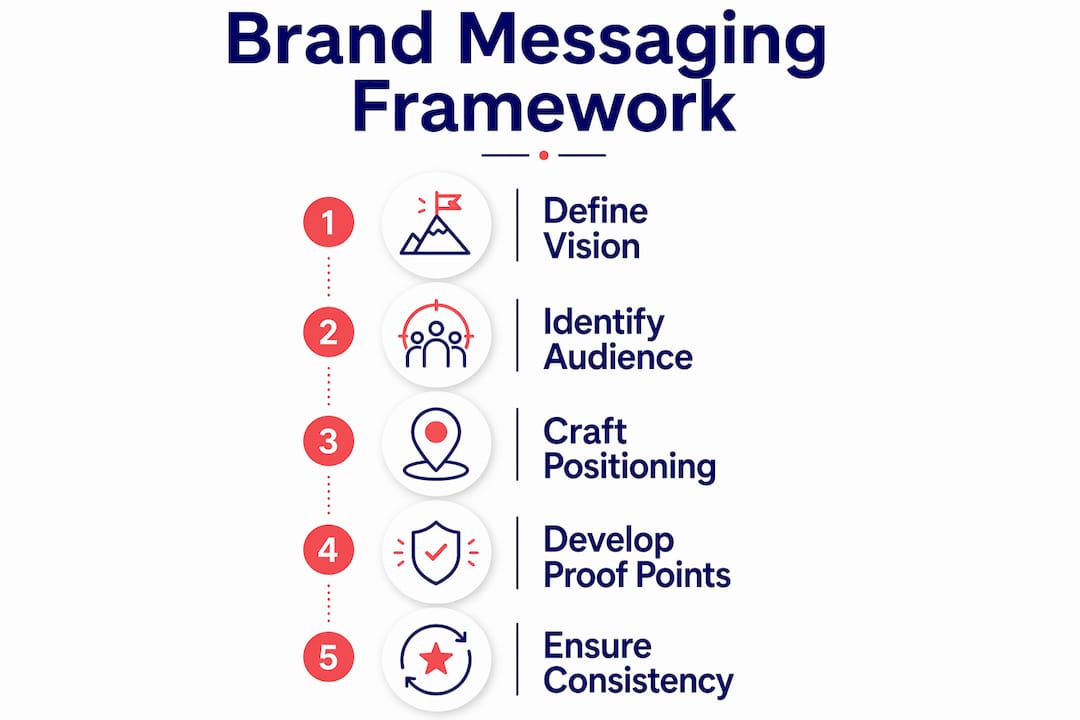
Brand consistency across channels directly supports long-term business growth. The 33% revenue uplift associated with consistent brand presentation is not accidental. It reflects the psychological principle that familiarity builds trust, and trust accelerates purchase decisions. A framework makes consistency repeatable rather than dependent on individual judgement.
The three Cs of brand messaging, which are clarity, consistency, and constancy, provide a practical test for any piece of communication. Is the message easy to understand? Does it match what the brand says elsewhere? Has it been maintained over time? A documented framework makes all three achievable at scale.
Consistency also strengthens brand recognition in competitive markets. When your audience can predict your tone and message, they begin to associate specific language patterns with your brand. That association is brand equity in its most practical form.
What are common frameworks and models used in brand messaging strategy?
Several established models give marketing teams a proven structure to build from. Each takes a different approach to organising the hierarchy of messages.
Common frameworks include StoryBrand, Message House, and Geoffrey Moore’s positioning template, each suited to different organisational needs and communication goals.
| Framework | Core focus | Best suited for |
|---|---|---|
| StoryBrand | Positions the customer as the hero, brand as guide | Consumer-facing brands with complex narratives |
| Message House | Hierarchical structure with one roof message and supporting pillars | B2B organisations needing internal alignment |
| Geoffrey Moore’s template | Precise competitive positioning statement | Brands entering or redefining a market category |
StoryBrand, developed by Donald Miller, restructures brand communication around the customer’s problem rather than the brand’s achievements. The result is messaging that feels relevant rather than self-promotional. Message House organises content into a single overarching message supported by three to five pillars, each with its own proof points. It works particularly well for organisations where multiple teams need to communicate independently but consistently. Geoffrey Moore’s positioning template forces clarity on competitive differentiation, making it a strong starting point for any brand that struggles to articulate why it is different.
The right model depends on your audience, your organisation’s size, and how much internal alignment you need to achieve. Many brands combine elements from more than one model to suit their specific context.
How to create and implement a brand messaging framework effectively
Building a messaging framework requires structured research before any writing begins. Rushing to craft copy without a foundation produces messaging that sounds good but fails to resonate with the right audience.
- Conduct audience research. Interview existing customers, analyse support tickets, and review sales call recordings. The language your audience uses to describe their problems is the language your messaging should reflect.
- Audit your current messaging. Gather all existing brand materials and assess them against the seven components. Identify gaps, contradictions, and inconsistencies before building anything new.
- Define your positioning statement. Use a structured template to articulate your market position clearly. This single statement becomes the foundation everything else is built upon.
- Draft your brand pillars. Choose three to five themes that are both true to your brand and meaningful to your audience. Each pillar should be distinct enough to generate unique content but connected enough to feel coherent.
- Write voice and tone guidelines. Document specific examples of on-brand and off-brand language. Abstract descriptions like “friendly but professional” are not enough. Show real sentences that demonstrate the difference.
- Gather and validate proof points. Collect data, case studies, and testimonials that support each pillar. Proof points should be specific and verifiable.
- Document and distribute the framework. A framework that lives in one person’s head or a single document no one can find is not a framework. It is a missed opportunity. Make it accessible to every team that communicates on behalf of the brand.
Cross-departmental collaboration is not optional during implementation. Sales teams often hold the most accurate picture of customer language, and product teams understand feature differentiation better than anyone. Involving them early produces a framework that reflects reality rather than marketing aspiration.
Pro Tip: Run a short workshop with non-marketing teams before finalising the framework. Ask them to describe the brand in three words and explain the core product benefit in one sentence. The gaps between their answers and your draft framework reveal exactly where alignment work is needed.
Refreshing your framework regularly keeps it relevant. A messaging refresh for existing audiences should happen whenever your product, audience, or competitive position changes significantly. Annual reviews are a sensible minimum.
Common challenges when using brand messaging frameworks
Even well-built frameworks encounter resistance in practice. Knowing the most common obstacles helps you address them before they undermine the work.
- Vague positioning. A positioning statement that could apply to any brand in your category provides no real direction. If your statement does not exclude some audiences or markets, it is not specific enough.
- Inconsistent use across teams. A framework only works if people use it. Without training and clear ownership, teams default to their own instincts. Assign a framework owner and build it into onboarding for new hires.
- Overcomplication. Frameworks that try to cover every scenario become too unwieldy to use. The best frameworks are concise enough to be memorised in outline and detailed enough to answer real questions.
- Lack of updates. A framework written three years ago may no longer reflect your audience, your product, or your market. Treat it as a living document with a scheduled review cycle.
- No leadership buy-in. When senior leaders communicate off-message, it signals to the rest of the organisation that the framework is optional. Leadership alignment is not a nice-to-have. It is the foundation of consistent brand communication.
The role of storytelling in branding is closely tied to how well these challenges are managed. Brands that treat their framework as a creative constraint rather than a creative enabler tend to produce the most compelling, consistent communication.
Key takeaways
A brand messaging framework is the single most effective tool for aligning how your entire organisation communicates, and consistency in that communication directly drives revenue growth.
| Point | Details |
|---|---|
| Framework definition | A structured system that organises all brand messages into a single, authoritative reference for every team. |
| Seven core components | Mission, positioning, audience profile, UVP, brand pillars, voice guidelines, and proof points form the complete framework. |
| Revenue impact | Consistent brand presentation across channels is linked to up to 33% higher revenue. |
| Implementation priority | Cross-departmental collaboration and accessible documentation determine whether a framework is actually used. |
| Ongoing maintenance | Regular reviews and a named framework owner prevent the drift that undermines brand coherence over time. |
Why brand messaging is a discipline, not a deliverable
Brand messaging frameworks are one of those areas where I see the same mistake repeated across organisations of every size. Teams treat the framework as a project with a finish line. They build it, present it, file it, and move on. Six months later, the sales deck contradicts the website, the social content has drifted in tone, and nobody can quite explain why the brand feels inconsistent.
The truth is that a messaging framework is a discipline, not a deliverable. It requires the same ongoing attention as a financial model or a product roadmap. The brands I have seen maintain the strongest long-term equity are the ones where someone, usually a senior communications lead, treats the framework as a living system rather than a completed document.
The other thing I would push back on is the idea that messaging frameworks are purely a marketing responsibility. The most powerful frameworks I have encountered were built with direct input from sales, customer success, and even product teams. Those perspectives surface the language real customers use, the objections that actually arise, and the proof points that genuinely shift decisions. Marketing alone rarely has all of that. A strong brand communications strategy is built on that kind of cross-functional honesty.
If you are starting from scratch, resist the temptation to write the framework in a single workshop. Give it time. Test messages with real audiences. Revise. The frameworks that last are the ones built with patience and evidence, not speed and assumption.
— Calum
How Michaelbell can help you build a clear brand messaging framework
Building a messaging framework that your whole organisation actually uses takes more than a template. It takes the kind of thinking that connects your external brand promise to your internal culture and operations.
Michaelbell specialises in exactly that. Our team works as an extension of yours, combining direct marketing expertise with internal communications thinking to build frameworks that hold together across every channel. Whether you are starting from scratch or need to bring coherence to a fragmented brand, our brand communications services are built to deliver real alignment without the overhead of an in-house agency. Get in touch and we will get straight back to you.
FAQ
What is a brand messaging framework in simple terms?
A brand messaging framework is a documented system that defines what a brand says, how it says it, and why. It gives every team a shared reference for consistent communication across all channels.
What are the key elements of a brand messaging framework?
The core elements are mission and vision, a positioning statement, target audience profile, unique value proposition, brand pillars, voice and tone guidelines, and proof points. Together, these seven components create a complete messaging system.
How does a messaging framework differ from a brand guidelines document?
Brand guidelines focus on visual identity, such as colour, typography, and logo usage. A messaging framework focuses on language, narrative, and the hierarchy of ideas a brand communicates. Both are needed, but they serve different functions.
How often should a brand messaging framework be updated?
A framework should be reviewed at least annually and updated whenever your product offering, target audience, or competitive position changes significantly. Treating it as a living document prevents brand drift over time.
Why does brand messaging consistency matter for revenue?
Organisations with consistent brand presentation across all channels experience up to 33% higher revenue than those without it. Consistency builds familiarity, familiarity builds trust, and trust accelerates purchasing decisions.