
Testing in data-driven marketing: a practical guide

Testing is the mechanism that turns marketing opinion into reliable evidence. When you run a controlled experiment, you stop guessing which headline converts better or which channel drives genuine incremental revenue, and you start making decisions grounded in causal proof. According to an Optimizely survey, almost half of companies credited experimentation with driving a 10% uplift in revenue. That figure alone makes the case.
The role of testing in data-driven marketing comes down to three things:
- Causality over correlation. Tests prove what actually moves the needle, not just what correlates with good results.
- Incremental value. Holdout and geo experiments reveal whether a channel is genuinely driving revenue or simply claiming credit for sales that would have happened anyway.
- Creative winners. Structured A/B and multivariate tests identify which messages, visuals, and formats resonate with real audiences.
Your immediate next step: pick one high-impact hypothesis you have been debating in your team, write it in if–then–because format, and commit to running a properly powered test before acting on the opinion.
Table of Contents
- What is experimentation in data-driven marketing?
- How testing materially improves marketing decisions
- Running an experiment end to end: a practical checklist
- Which tools should your experimentation stack include?
- Governance, ethics and GDPR considerations for UK teams
- What high-performing organisations do differently
- Common mistakes that make test results misleading
- A 30–90 day roadmap for UK marketing teams
- Key takeaways
- Why testing culture matters more than testing tools
- How Michaelbell can help you build a testing programme
What is experimentation in data-driven marketing?
Testing in a marketing context means running a hypothesis-driven, controlled experiment where you change one or more variables, measure a defined outcome, and draw a conclusion you can act on. The key word is controlled: without a comparison group, you have an observation, not evidence.
The five primary test types cover most situations a UK marketing team will encounter.
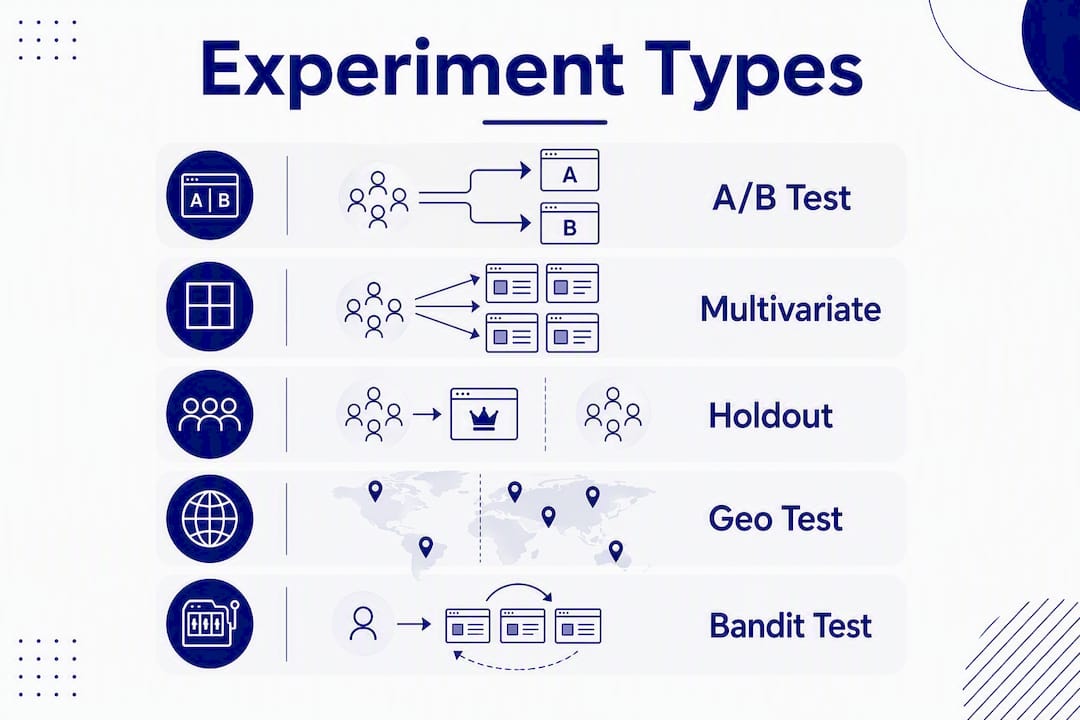
| Test type | Purpose | Complexity | Sample sensitivity | Common use case |
|---|---|---|---|---|
| A/B (split) | Compare two variants on a single variable | Low | High | Email subject lines, landing page CTAs |
| Multivariate | Test combinations of multiple elements simultaneously | Medium–High | Very high | Homepage layouts, ad creative combinations |
| Holdout / incrementality | Measure causal media lift by withholding treatment from a control group | Medium | Medium | Paid media, CRM campaigns |
| Geo experiment | Market-level causal test when user-level randomisation is not possible | High | Low–Medium | TV, OOH, broad digital campaigns |
| Pre-post | Quick before/after comparison with no control group | Low | N/A | Rapid sanity checks, small-budget tests |
A few practical points on choosing the right method:
- Use A/B testing when you want to isolate a single variable — a subject line, a CTA colour, a pricing message. It is the workhorse of digital experimentation.
- Use multivariate when you need to understand how combinations of elements interact, but only when you have sufficient traffic to power it properly.
- Use holdout or geo experiments when user-level randomisation is not feasible — for example, when measuring the incremental impact of a TV burst or a broad paid social campaign.
- Use pre-post only as a directional signal, never as proof. Seasonality, competitor activity, and external events all confound the result.
How testing materially improves marketing decisions
Organisations that prioritise testing are more likely to significantly outperform competitors, according to Gartner survey analysis. That gap is not about having more data. It is about using experiments to move from correlation to causation, so that budget and creative decisions rest on evidence rather than instinct.
Here is how that plays out in practice:
- Channel budget allocation. A holdout test on paid social reveals whether switching off spend causes a measurable drop in conversions, or whether organic and direct traffic absorbs the volume. The result directly informs how much to invest next quarter.
- Creative selection. Rather than letting the loudest voice in the room choose the campaign visual, an A/B test on a sample audience decides it. The winner gets the full budget.
- Personalisation algorithm tweaks. Testing different segmentation rules or recommendation logic against a control group shows whether a personalisation change genuinely lifts engagement or just looks good in a dashboard.
- Pricing and offer mechanics. Structured tests on discount depth, urgency messaging, or bundle framing quantify the revenue trade-off before a decision is rolled out at scale.
- CRM and email cadence. Frequency tests on email send rates prevent the common mistake of over-mailing an audience based on open-rate averages that mask unsubscribe behaviour.
The practical flow is straightforward: experiment → evidence → decision. You form a hypothesis, run the test, read the result, and update your strategy. Leveraging customer data at each stage makes the evidence sharper and the decisions faster.

Running an experiment end to end: a practical checklist
A well-run experiment follows a consistent sequence: hypothesis → design → sample and duration → run → analyse → act → document. Skipping any step tends to produce results you cannot trust or act on.
1. Write a testable hypothesis
Frame it as: If [change], then [outcome], because [reason]. For example: “If we replace the generic hero image with a product-in-use photo, then click-through rate will increase, because it shows the product in context.”
2. Define your primary KPI before you start
One primary metric drives the decision. Secondary metrics provide context. Changing goals mid-test invalidates the result.
3. Calculate sample size and duration using power analysis
Power analysis sets the minimum sample size and duration needed to detect your minimum detectable effect (MDE) at a chosen confidence level. Most teams use 95% confidence and 80% statistical power as defaults. Run the numbers before you start, not after.
4. Allocate traffic and randomise correctly
Split traffic randomly between control and variant. Avoid self-selection bias by ensuring the split happens at the point of exposure, not at the point of conversion.
5. Set stopping rules and stick to them
Predefine the sample size you need and do not read the results until you reach it. Stopping tests early inflates false positives and produces unreliable winners — a well-documented failure mode that affects even experienced teams.
6. Analyse with appropriate statistical methods
Check for novelty effects (a short-term spike that fades), segment the results by meaningful audience cuts, and apply regression adjustments where confounding variables are present.
7. Act on the result and document everything
A result only has value if it changes a decision. Record the hypothesis, sample size, duration, KPIs, outcome, and the decision taken in a centralised learning repository so the knowledge survives team changes.
Pro Tip: Pre-register your stopping rules in writing before the test goes live. If you have not committed to a sample size in advance, the temptation to “peek” at interim results and call a winner early is almost irresistible — and almost always misleading.
Which tools should your experimentation stack include?
The minimum viable stack for a UK marketing team has five layers: tag management, consent and identity, analytics, an experimentation platform, and a learning repository. Every layer needs to talk to the next, and the consent layer must gate everything upstream of it.

Tag management and tracking
Google Tag Manager or a server-side equivalent captures events reliably without polluting your data with unconsented signals. Server-side tagging is increasingly preferred for GDPR compliance because it gives you control over what fires and when.
Consent and identity layer
A consent management platform (CMP) such as OneTrust or Usercentrics sits between the user and your tracking. Under UK GDPR, you need a lawful basis for processing personal data in experiments. For most behavioural tests, that means explicit consent or a legitimate interest assessment that holds up to scrutiny.
Analytics platform
Google Analytics 4, Adobe Analytics, or Mixpanel provide the event data your experiments run on. The key requirement is consistent event naming and a clean data layer — without it, your experiment results are only as reliable as your tracking.
Experimentation platform
Tools such as Optimizely, VWO, or AB Tasty handle variant assignment, traffic splitting, and statistical calculations. For teams running conversion rate optimisation at scale, a dedicated platform beats a manual implementation every time.
Learning repository
A shared document, Notion workspace, or purpose-built tool like Airtable records every experiment’s hypothesis, result, and decision. Without it, institutional knowledge disappears when people move roles.
For teams running geo or holdout experiments, a customer data platform (CDP) that unifies behavioural signals and supports data-driven targeting adds significant value at the identity and segmentation layer.
Governance, ethics and GDPR considerations for UK teams
Governance does not have to slow you down. Lightweight rules and clear decision rights protect test velocity while keeping experiments lawful and defensible.
GDPR compliance checklist for UK experiments:
- Lawful basis. Identify whether you are relying on consent or legitimate interest for each experiment type. Personalisation tests that process identifiable data almost always require consent.
- Consent capture. Your CMP must record consent before any tracking fires. Retroactively applying consent to existing data is not compliant.
- Data minimisation. Collect only the data points the experiment genuinely requires. Do not capture additional behavioural signals “in case they are useful later.”
- Pseudonymisation and hashing. Where possible, hash user identifiers before passing them to your experimentation platform. Anonymised aggregate tests (e.g., geo experiments) carry lower compliance risk than user-level personalisation tests.
- Retention limits. Define how long experiment data is held and delete it when the retention period expires.
- Record-keeping. Document the purpose, lawful basis, and legitimate interest assessment for every experiment. The UK GDPR requires you to demonstrate compliance, not just claim it.
Operational governance:
- Maintain an experiment register listing every live and completed test, its owner, and its approval status.
- Set approval guardrails for high-risk tests — for example, any experiment that changes pricing, involves sensitive data categories, or affects a vulnerable audience segment.
- Keep an audit trail of decisions taken from experiment results so you can explain why a change was made if challenged.
- Consult ICO guidance on legitimate interest assessments and data minimisation when designing experiments that process personal data.
What high-performing organisations do differently
Organisations that run tests at higher velocity learn faster and improve long-term marketing performance more consistently. Testing velocity — how many experiments a team runs — is one of the most predictive indicators of sustained performance improvement. This is not about running tests for the sake of it. It is about building a system where learning compounds.
The evidence from high-performing organisations is instructive:
| Organisation | Testing approach | Reported outcome |
|---|---|---|
| Booking.com | — | Channel spend and UX decisions guided by live evidence |
| Netflix | Large-scale A/B tests combined with ML models | Improved paid media effectiveness and on-platform personalisation |
| Philips | Continuous content testing across multiple markets | a large increase in newsletter signups from a single CTA change |
| Airbnb | Custom A/B testing framework for rapid iteration | Statistically sound results on ranking, messaging and UX |
The common thread is not budget or headcount. It is a culture where well-designed experiments are celebrated regardless of outcome. Psychological safety — leadership actively rewarding teams for running bold, well-structured tests even when they return null results — is what separates organisations that learn from those that stagnate.
Practical steps to build that culture:
- Management sponsorship. A senior leader who publicly shares experiment results (including failures) sets the tone.
- Centralised learning repository. Every test result, positive or negative, goes into one shared record. Teams stop repeating failed experiments.
- Experiment prioritisation framework. Use a simple scoring model (potential impact × confidence × ease) to decide which hypotheses to test first, rather than defaulting to the most politically visible idea.
Pro Tip: Run a monthly “learning review” where the team presents one experiment result — win or loss — and the decision it informed. This single habit builds more test-and-learn culture than any process document.
Common mistakes that make test results misleading
The usual failure modes make tests misleading, not useless. Every one of them is avoidable with the right discipline applied before the test goes live.
- Peeking at interim results. Checking significance before reaching your pre-defined sample size inflates false positives. Fix: commit to a sample size in writing before launch and do not read results until you hit it.
- Underpowered tests. Running a test on too little traffic means you cannot detect a real effect even when one exists. Fix: use power analysis to set your MDE and required sample size before designing the test.
- Testing multiple variables at once. Changing more than one element simultaneously makes it impossible to attribute the result to any single change. Fix: isolate one variable per test unless you are running a properly designed multivariate experiment with sufficient traffic.
- Novelty effects. A new variant often gets a short-term engagement spike simply because it is different. Fix: run tests for a minimum of two full business cycles before drawing conclusions.
- Ignoring seasonality and external events. A test running across a bank holiday or a major news event will produce confounded results. Fix: document external events in your experiment log and factor them into your analysis.
- Multiple comparisons without correction. Testing ten variants and picking the winner inflates your false positive rate significantly. Fix: apply a Bonferroni correction or use a sequential testing method designed for multiple comparisons.
- Changing the primary KPI after launch. If the original metric does not move but a secondary one does, it is tempting to declare victory on the secondary. Fix: lock the primary KPI before the test starts and treat secondary metrics as hypotheses for the next experiment.
When a live test looks “too good to be true,” check:
- Did the test start during an unusual traffic period?
- Is the variant receiving a disproportionate share of a high-value segment by chance?
- Has anything else changed in the product, pricing, or media mix since launch?
- Is the sample size large enough to be confident, or are you reading noise?
A 30–90 day roadmap for UK marketing teams
A phased plan moves you from a single validated test to a repeatable operating rhythm. You do not need a large budget or a dedicated data science team to start.
Days 1–30: audit and first hypothesis
- Audit your current tracking setup. Identify gaps in event coverage and confirm your consent management is GDPR-compliant.
- Map your highest-traffic conversion points. These are your best candidates for early tests because small improvements have the largest absolute impact.
- Write your first hypothesis in if–then–because format. Keep it simple: one variable, one metric.
- Calculate the sample size you need using a free power analysis tool (e.g., Evan Miller’s sample size calculator).
- Set up your experiment in your chosen platform and confirm randomisation is working correctly before going live.
Days 31–60: run, analyse, and document
- Let the test run to its pre-defined sample size. Resist the urge to peek.
- Analyse the result against your primary KPI. Note secondary metrics as context, not as the decision driver.
- Document the full experiment in your learning repository: hypothesis, sample size, duration, result, decision, and next steps.
- Share the result with the wider team, regardless of outcome.
Days 61–90: scale and build rhythm
- Roll out the winning variant (or return to baseline if the test was inconclusive) and move to the next hypothesis.
- Establish a fortnightly experiment review cadence.
- Build a prioritised backlog of hypotheses using an impact-confidence-ease scoring model.
Indicative resource and cost guidance:
- In-house analyst time: a few days per experiment for setup, monitoring, and analysis at the early stage.
- Experimentation platform: SaaS licences for tools such as VWO or AB Tasty typically start from a modest monthly cost for small-to-medium traffic volumes. Enterprise platforms carry higher costs.
- Agency support: An agency partner can compress the setup phase significantly, particularly for teams without an existing analytics infrastructure. A discovery and audit engagement typically runs from a half-day to two days of consultancy time.
For teams also building out their marketing automation infrastructure in parallel, integrating experiment event tracking with your automation platform early avoids costly rework later.
Key takeaways
Testing converts marketing opinion into causal evidence, and the teams that run experiments at pace and document every result consistently outperform those that rely on instinct alone.
| Point | Details |
|---|---|
| Test one hypothesis at a time | Isolate a single variable per experiment so results can be attributed with confidence. |
| Predefine success rules | Set your primary KPI, sample size, and stopping rules before the test goes live to avoid false positives. |
| Document every experiment | A centralised learning repository prevents repeated failures and preserves knowledge when team members change roles. |
| Protect consent and privacy | Under UK GDPR, establish a lawful basis for every experiment that processes personal data and record it in writing. |
| Michaelbell integrates testing into campaign work | Michaelbell embeds experiment design, learning repositories, and GDPR-aware governance into its agency partnerships. |
Why testing culture matters more than testing tools
The most common mistake marketing teams make is treating experimentation as a technical problem. They invest in an experimentation platform, run a handful of A/B tests, and then wonder why the programme stalls after six months. The platform is not the constraint. The culture is.
What actually separates high-velocity testing organisations from the rest is not the sophistication of their tools. It is the degree to which leadership treats a well-designed null result as a genuine win. A test that proves your hypothesis wrong has saved you from rolling out a change that would have cost you conversions at scale. That is valuable. But most marketing teams are not rewarded for it, so they run safe, low-ambition tests that confirm what they already believe.
The second underestimated factor is the learning repository. Booking.com and Netflix run thousands of experiments because they have built institutional memory. Every test result feeds back into the next hypothesis. Without that documented record, each experiment is an island. You learn something, the team changes, and six months later someone runs the same test again.
The practical implication for UK marketing teams is this: before you spend a penny on tooling, invest in the governance and documentation habits that make testing compound over time. A shared Notion page and a fortnightly review meeting will do more for your test-and-learn programme than a premium platform licence used without discipline. The business case for brand investment applies equally to experimentation infrastructure: the returns are long-term, and they accrue to teams that treat it as a discipline, not a project.
How Michaelbell can help you build a testing programme
Michaelbell offers marketing teams a concrete alternative to building an experimentation capability entirely in-house. Rather than hiring a dedicated analyst, procuring multiple platform licences, and spending months on setup, you get an embedded agency partner who brings the methodology, the governance framework, and the creative expertise together from day one.
Our experimentation support covers experiment design and hypothesis development, tracking and consent setup, A/B and multivariate test execution, results analysis, and learning repository management. We work alongside your existing team, so knowledge transfers rather than sits with an external supplier. Discovery conversations typically run to one hour and cover your current analytics maturity, your highest-priority conversion points, and a realistic 90-day plan.
If you are ready to move from opinion-driven decisions to evidence-driven ones, explore our services or map your customer journey with us as a starting point.
Useful sources and further reading
- ICO — UK GDPR guidance: The Information Commissioner’s Office publishes practical guidance on lawful basis, legitimate interest assessments, and data minimisation — essential reading before designing any experiment that processes personal data.
- Google’s marketing experiment playbook: Covers core experiment principles, metric selection, controlled randomisation, and holdout/geo designs. Useful for teams building their first methodology framework.
- Capgemini — How test and learn delivers value in data-driven marketing: Combines Gartner survey data with practitioner guidance on learning repositories, power analysis, and test culture. One of the more substantive practitioner essays available.
- CDP.com — Data-driven marketing glossary: Useful background on how CDPs support unified identity and behavioural data, which underpins reliable experiment segmentation.
- Sojern — Creative testing in data-driven marketing: Focused specifically on creative variable isolation and the discipline of single-variable testing for campaign assets.
- UK Data Protection Act 2018: The primary legislation governing data processing in the UK, including the UK GDPR framework that applies to marketing experiments involving personal data.