
How to leverage customer data for brand communications

The most effective way to use customer data in brand communications is to unify four types of signal into a single customer view, then build every message from that foundation. Companies that maintain consistent brand presentation across touchpoints can see up to 33% higher revenue. That figure alone makes the case for treating data not as a reporting asset but as the engine of your messaging system.
Your one-line action plan: identify your highest-impact use case, unify the relevant data into your CRM or CDP, define three message pillars, and run one A/B experiment within 30–60 days.
Here is who owns each step:
- Marketing lead: defines the use case, message pillars, and experiment hypothesis
- Data owner: maps identity fields, applies consent flags, and connects data sources
- Creative lead: translates pillars into channel-specific copy and templates
Table of Contents
- Why customer data should sit at the centre of brand communications
- The four data pillars every brand communications strategy needs
- How do you turn siloed data into a single customer view?
- UK GDPR compliance checklist for data-driven brand communications
- How do you build a single messaging system from customer data?
- How do you measure the impact of data-driven messaging?
- A practical 90-day rollout plan for UK marketing teams
- Key takeaways
- The gap between data strategy and brand reality
- How MB Brand Communications supports your first 90 days
- Sources and further reading
Why customer data should sit at the centre of brand communications
Consistent, data-driven communications reduce the cognitive friction that slows purchase decisions. When your website, ads, email, and support team all say the same thing in the same tone, customers move faster from awareness to conversion.
Consistent brand presentation can lift revenue by up to 33%. That is not a brand-awareness metric; it maps directly to conversion rate, customer acquisition cost, and lifetime value. A practical example: a B2B team that aligns its support scripts, paid ads, and onboarding emails around a single data-informed message pillar typically shortens its sales cycle because prospects stop receiving contradictory signals at different stages.
Stat to know: Up to 33% higher revenue is the documented upside of consistent brand presentation across touchpoints.
Smaller teams can also drive real value by analysing existing data sources such as email lists and purchase history, without building enterprise infrastructure first.
The four data pillars every brand communications strategy needs
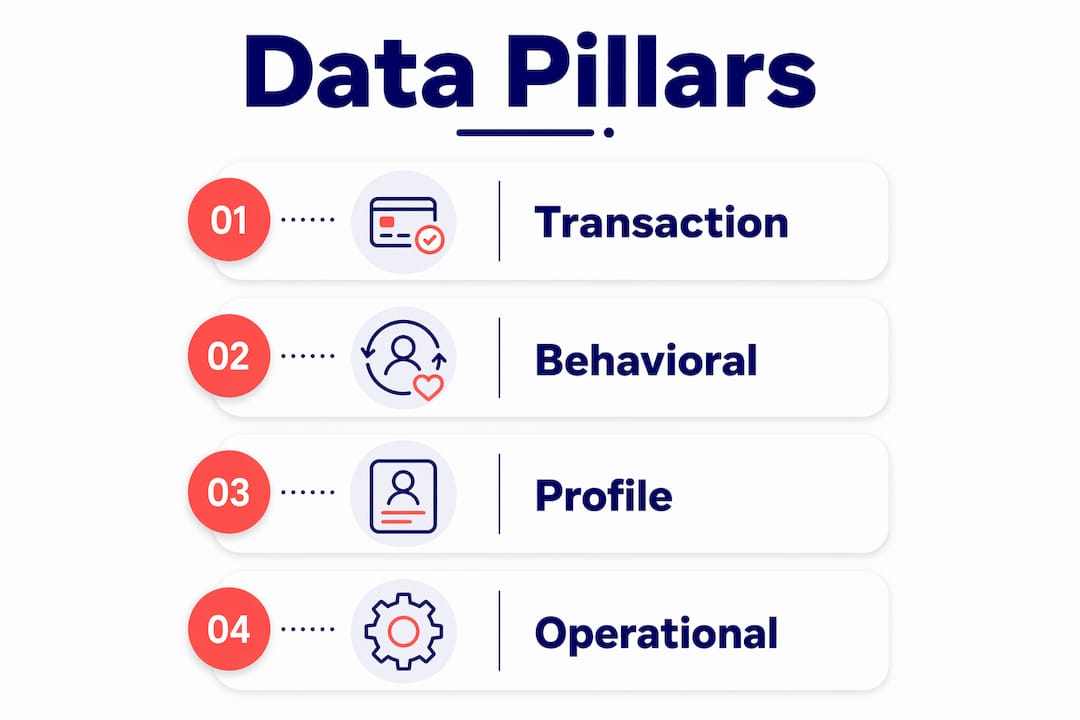
The four core pillars are direct feedback, behavioural data, transaction history, and operational metrics. Each one tells a different part of the customer story.
- Direct feedback: surveys, NPS scores, and post-purchase reviews. Use these to surface the exact language customers use about your product, then mirror it in your copy.
- Behavioural data: session recordings, page events, email opens, and click paths. These reveal intent gaps between what customers say and what they actually do.
- Transaction history: purchase cadence, average order value, product combinations, and churn timing. This pillar powers segmentation and lifecycle messaging.
- Operational metrics: support ticket volume, SLA adherence, and resolution times. These expose friction points that brand messaging can either address or inadvertently promise to fix.
Pro Tip: Start with transaction history. It is already clean, structured, and sitting in your CRM. Activating it for lifecycle messaging delivers visible results within weeks and builds internal confidence for the more complex behavioural work that follows.
How do you turn siloed data into a single customer view?
The most valuable insights live in the white space between departments. Joining behavioural and operational data is where the real picture of your customer emerges.

| Tool type | Primary role | Best for |
|---|---|---|
| CRM | Transaction and relationship data | Sales cycles, lifecycle triggers |
| CDP | Identity stitching and real-time activation | Cross-channel personalisation |
| Data lake | Analytics and modelling | Reporting, long-term trend analysis |
The critical distinction: organisations often build data stores but fail to create an activation layer. A data lake full of insight is useless if your email platform cannot query it in real time. Design for activation first.
Implementation checklist:
- Map identity fields across systems (email, customer ID, device ID)
- Define a shared event taxonomy (e.g.
purchase_completed,form_submitted) - Apply consent flags at the point of collection, not retrospectively
- Prioritise the two integrations that unlock your first experiment
- Set a 90-day deliverable: one triggered campaign live and measured
Centralising data into a unified view stops teams checking multiple systems and enables faster, proactive outreach. That speed advantage compounds over time.
UK GDPR compliance checklist for data-driven brand communications
Treat data collection as a value exchange. High-performing brands offer tangible benefits such as personalised recommendations or loyalty rewards in return for first-party data and consent. That approach raises both consent rates and data quality simultaneously.
- Lawful basis: document the lawful basis for each data use (consent, legitimate interest, contract). Do not default to legitimate interest for marketing without a balancing test.
- Consent UX: make opt-in granular, specific, and easy to withdraw. Pre-ticked boxes are not valid under UK GDPR.
- Preference centre: give customers control over channel, frequency, and topic. This reduces unsubscribes and improves signal quality.
- DPIA triggers: run a Data Protection Impact Assessment before deploying any new profiling or automated decision-making system.
- Retention schedules: set and enforce data retention limits by category. Stale data degrades personalisation and increases compliance risk.
- Vendor processors: confirm every third-party tool has a current Data Processing Agreement in place.
- Pseudonymisation: apply pseudonymisation to activation datasets so personal identifiers are separated from behavioural profiles.
Pro Tip: Behavioural data carries privacy and quality risks that compound over time. Audit your data sources for accuracy and bias before building personalisation logic on top of them.
This checklist is general guidance, not legal advice. Consult a qualified privacy professional for complex cases and cross-border data transfers.
How do you build a single messaging system from customer data?
A brand messaging strategy is a system, not just copy. It must align teams, channels, and content around a single narrative. The practical way to do that is to convert your segments into message pillars, then map each pillar to a customer journey.
“Your messaging communicates your brand story. This develops trust between your brand and your customers.” — Asana Brand Messaging Framework
Segment naming convention example: use a format like [Lifecycle stage]_[Value tier]_[Primary need] (e.g. Active_High_Support). This makes it easy to link each segment to the right pillar and brief any channel team quickly.
Journey map snippet for a high-value active segment:
| Stage | Core message | Channel example |
|---|---|---|
| Awareness | “We understand your specific challenge” | Paid social headline |
| Consideration | “Here is proof it works for teams like yours” | Email case study |
| Purchase | “Simple to start, no long-term commitment” | Landing page CTA |
| Retention | “You are getting more value than you realise” | In-app or support script |
Pro Tip: Build your brand voice development document before writing channel templates. Without a shared voice guide, channel adaptations drift and the single customer view becomes a single data view with fragmented messaging on top.
How do you measure the impact of data-driven messaging?
Measure business outcomes first, then link them to messaging experiments. Run A/B or holdout tests with pre-defined KPIs and proper attribution windows before you launch, not after.
KPI list:
- Conversion rate by segment (primary)
- Message lift (variant vs control)
- Time to purchase
- NPS and CSAT delta after messaging change
- Churn rate by cohort
- Attribution window: use 7-day and 30-day windows and compare
Experiment checklist:
- Write the hypothesis before building the test: “If we change X for segment Y, we expect Z because of W.”
- Set a minimum detectable effect and sample size before launch
- Assign a single owner for each role: designs test, executes, signs off, reports
Analytics-driven marketing moves teams from reactive reporting to proactive, real-time decisions. The discipline of pre-defined success criteria is what separates learning programmes from one-off tests.
A practical 90-day rollout plan for UK marketing teams
Focus the first 90 days on one activation use case, identity stitching, one experiment, and governance setup.
| Phase | Weeks | Key tasks | Owner | Success metric |
|---|---|---|---|---|
| Foundation | 1–4 | Audit data sources, map identity fields, document consent, define one use case | Data owner, legal | SCV draft complete |
| Build | 2–3 days per week | Connect CRM/CDP, build segment, create message pillar and templates, set up experiment | Data engineer, creative lead | First triggered campaign live |
| Measure | — | Run experiment, report results, refine governance, brief next use case | Marketing lead | Conversion lift measured |
Effort and cost considerations: a lean internal team typically needs 2–3 days per week across the three roles in phases one and two. External agency support for strategy and creative reduces that load significantly. Low-complexity implementations (existing CRM, one channel) sit at the lower end of effort; CDP deployments with multiple integrations sit higher. Get a scoped estimate before committing to tooling.
Briefing an agency: share your data audit, your one use case, your three message pillars, and your experiment hypothesis. That four-point brief gives MB Brand Communications everything needed to hit the ground running on customer journey work from week one.
Key takeaways
Using a unified customer data view to power consistent, personalised brand communications is the single most direct route to higher conversion, lower acquisition cost, and stronger customer retention.
| Point | Details |
|---|---|
| Unify before you personalise | Build a single customer view from the four data pillars before writing a single message variant. |
| Activate, do not just analyse | Design your CRM or CDP for real-time triggering, not only reporting. |
| Govern from day one | Apply consent flags, retention schedules, and DPAs before your first campaign goes live. |
| Test with a hypothesis | Every messaging experiment needs a written hypothesis and pre-defined KPIs before launch. |
| Michaelbell accelerates the plan | MB Brand Communications maps strategy, creative, and activation to your 90-day milestones as an extension of your team. |
The gap between data strategy and brand reality
Most marketing teams do not have a data problem. They have a translation problem. The data exists. The segments exist. What is missing is the step that converts a segment definition into a message that actually sounds like the brand, holds up across every channel, and gives a customer a reason to feel something.
The four-pillar framework and the 90-day plan in this guide are genuinely useful. But the teams that get the most from them are the ones who treat the messaging system as a living document, not a one-time deliverable. They revisit their message pillars when NPS shifts. They update their journey maps when transaction data shows a new drop-off point. They brief their creative teams with data, not just briefs.
The other thing worth saying plainly: compliance is not a blocker to personalisation. UK GDPR, handled properly, is a framework for building trust. Brands that collect data transparently, offer real value in exchange, and give customers genuine control tend to end up with cleaner data and higher engagement than those who treat consent as a legal checkbox. That is not a coincidence.
How MB Brand Communications supports your first 90 days
The fastest way to close the gap between your data and your brand communications is to have a team that does both. MB Brand Communications covers strategy, creative, and activation as a single, joined-up service, so you are not briefing three separate suppliers across the phases of your rollout.
For teams at the start of their 90-day plan, we offer a focused strategy sprint: a structured session that produces your data audit summary, your three message pillars, and your first experiment brief. No long-term contract, no agency overhead. Just a clear plan your team can execute, with us alongside you as much or as little as you need. Speak to the MB team to scope your first sprint.
Sources and further reading
| Source | What it supports |
|---|---|
| Advergize: Brand Messaging Strategy Framework | 33% revenue finding; messaging system rationale |
| Monday.com: How to Use Data to Improve Customer Experience | Four data pillars; centralisation; experiment framework |
| Qualtrics: Customer Data Types and Collection Methods | Silo gaps; AI analytics for real-time decisions |
| Databricks: Last Mile First-Party Data | Activation layer; CRM/CDP design principles |
| Shopify Enterprise: How to Collect Customer Data | Value exchange; consent UX best practice |
| ScienceDirect: Behavioural Data and Data Quality | Privacy risk; data quality challenges |
| CIO: 7 Ways Small Businesses Can Leverage Customer Data | Phased rollout; low-cost wins for lean teams |
| Asana: Brand Messaging Framework | Messaging components; voice and tone alignment |
| Michaelbell: Benefits of Unified Brand Messaging | Agency context; messaging unification frameworks |